Monday, November 18, 2019

Less strict to free movement of people across Africa


By David Whitehouse

African governments need to reduce tariffs and non-tariff barriers in order to increase regional trade. REUTERS/Thomas Mukoya


African countries are becoming increasingly open to visitors from across the continent, with most countries making “steady progress” in terms of visa openness, according to the Africa Visa Openness Index presented by the African Union Commission and the African Development Bank at the Africa Investment Forum (AIF) in Johannesburg last week.

For the first time, Africans need visas to travel to less than half of other African countries, the report finds. A record 87% of African countries either improved or maintained their score, an increase of 9 points from 2018.

The biggest improvements were made by Ethiopia, which moved up 32 places to join the top 20 in terms of openness, mirroring the country’s progress in the World Bank’s Ease of Doing Business Index.

Senegal’s move to introduce visas on arrival for some African countries and removing visas required before travel pushed it up into the top 10.

Yet the freedom of movement that will be needed to make the Africa Continental Free Trade Area (AfCFTA) a success remains a work in progress.

Africa’s infrastructure deficit was a central theme at the AIF, which highlighted the need to attract investment into large-scale railway and road projects. Such projects will both require and further stimulate the free movement of people.

Only two African countries, Seychelles and Benin, offer visa-free access to all Africans.
Higher income African countries are among the laggards. Seven out of eight of Africa’s upper-middle income economies have low visa openness scores, the report finds.

Egypt, Morocco, Algeria and Cameroon remain near the bottom of the table.

Trust deficit

The absence of the protocol for free movement of persons was a notable omission from the agenda at the African Union Summit in Niger in July, according to a paper by Mehari Taddele Maru of the Migration Policy Centre at the European University Institute in Florence. The AfCFTA was launched at the Niger summit.

Mehari Taddele Maru argues that a trust deficit and the negative mindset of government officials are key constraints, and arise from a lack of political will and determination.

“The logic of states is usually to control their borders; hence, free movement of people impinges on sovereignty.”

Regardless of the existence of a free movement regime, African states are vulnerable to threats from within as much from without, the paper says.

Security threats are increasingly likely to be homegrown rather than imported, the paper finds.
These threats are “not the necessary result of free movement, but mainly arise from limited or non-existent capabilities of the state to effectively differentiate ‘good’ mobility . . . from ‘bad’ mobility, such as trafficking, smuggling and irregular migration.”

A true free mobility regime requires “better-resourced airports and border posts and significant work and investment in border governance,” Mehari Taddele Maru writes.


Thanks for reading. Follow the page and Share it.

Saturday, November 16, 2019

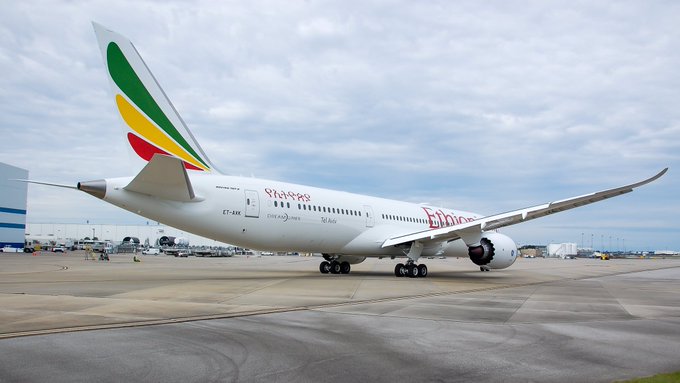
Ethiopian Airlines names new Dreamliner plane ‘Tel Aviv’


Aircraft’s moniker said to have been a secret that was to be revealed at Ben Gurion Airport ceremony
Am eagle-eyed plane spotter has noticed the name of one of the new Dreamliner planes ordered by Ethiopian Airlines: Tel Aviv.


The plane’s name was revealed as it left the Boeing plant in Charleston, South Carolina.
According to the Ynet news site, the moniker was supposed to be a surprise and was to be revealed in a ceremony at Ben Gurion airport.

The Ethiopian state airline operates two daily flights between Tel Aviv and Addis Ababa.


See Devin | Charleston SC Spotter's other Tweets


In March, a Boeing 737 MAX 8 Ethiopian Airlines Flight 302 went down six minutes after takeoff, apparently due to a technical malfunction, killing all 157 people on board.

Thanks for reading. Follow the page and Share it.

Africa in the news: Billion-dollar valuation for Nigerian tech company, Kenya-Somalia relations, and new Zimbabwe bank notes


Nigerian financial technology company Interswitch valued at $1 billion: In a statement released Tuesday, November 12, Visa confirmed that it would buy a 20 percent stake in Nigerian financial technology company Interswitch, for a total of $200 million. This investment will result in a billion-dollar valuation for Interswitch, Nigeria’s largest electronic payments company, giving it the so-called “unicorn” status attributed to privately held startup companies valued above $1 billion.

The investment makes Interswitch one of the most valuable African financial technology businesses and Africa’s only current technology-industry unicorn, after previous Nigerian unicorn Jumia’s worth dropped below $1 billion in the months following an April initial public offering (IPO). Interswitch is still planning to pursue its own IPO, which is expected to occur in 2020.

Kenya and Somalia normalize bilateral relations

Kenya and Somalia agreed to restore ties on Thursday, November 14, after a meeting between Kenyan President Uhuru Kenyatta and Somali President Mohamed Abdullahi Farmaajo in the Kenyan capital of Nairobi. The normalization of relations will begin with the restoration of visa policy that allows free movement of people between the countries. Aviation authorities will also work to restore direct flights between Nairobi and Mogadishu.

The agreement to normalize relations follows a months-long dispute over oil rights in the Indian Ocean, with the two countries contesting ownership of a territory thought to be rich in hydrocarbons. In 2014, Somalia sought arbitration from the United Nations International Court of Justice over this issue; Kenya has said it prefers an out-of-court settlement.

In other Somalia news, the top general for U.S. military operations in Africa, General Stephen Townsend, visited Somalia on Tuesday to discuss the fight against extremists in the country. Townsend discussed security developments with Farmaajo and the chief of staff of the Somali Armed Forces. The trip occurred as Somalia-based al-Qaeda affiliate al-Shabaab released a video calling for its fighters to target U.S. interests worldwide.

Zimbabwe introduces new bank notes

This week, Zimbabwe introduced new low-denomination $2 and $5 notes and coins in an attempt to end the country’s cash shortage. The cash shortage, along with shortages of staple goods exacerbated by drought, has driven inflation to its highest level since 2008, estimated to be 380 percent year-on-year.

The introduction of the new bank notes faced several challenges. Although scheduled to be distributed on Monday, November 11, many banks in Zimbabwe did not receive their allocations of the new bank notes on this date. Additionally, bank customers were frustrated by withdrawal limits of $20 per week. Despite these withdrawal limits, money was alleged to be found on the black market shortly after being released to banks.


Thanks for reading. Follow the page and Share it.

President Buhari Returns to Nigeria After Being Booed By Protesters


The President had been on a 15–day “private visit” in the United Kingdom since November 2.
President Muhammadu Buhari has departed London, United Kingdom, for Nigeria and is expected late on Friday.

#RevolutionNow Protesters had on Thursday gathered outside the Abuja House where Buhari was believed to have stayed to demand the release of rights activists, Omoyele Sowore and Olawale Bakare widely known as Mandate.

On Friday, a video that went viral showed a vehicle conveying President Buhari being conveyed out of Abuja House as angry protesters booed him.

The President’s flight was said to have taken off from Stansted Airport, London, at about 3:27pm Nigerian time, Premium Times reports.

Sources at the presidency said they had been asked to be at the airport by 7:30pm to welcome Buhari, who is expected to arrive at about 9:00pm.

The President had been on a 15–day “private visit” in the United Kingdom since November 2. 
He was due to return on November 17.


Thanks for reading. Follow the page and Share it.

Friday, November 15, 2019

DRC: The pro-Kabila faction paves the way for his return


By Stanis Bujakera Tshiamala

Joseph Kabila, at the inauguration of Felix Tshisekedi, on January 24, 2019. Jerome Delay/AP/SIPA


The Kabila-controlled party, the Common Front for Congo (FCC), launched a debate at the end of October on the eligibility of Joseph Kabila and on possible constitutional reform.

It had one objective, namely “to prepare the opinion” and gauge how the public perceives the possible return of the former Congolese president.

The strategy deployed by the leaders of the coalition, which has chosen former President Joseph Kabila as its “moral authority”, is stirring up the Congolese political scene.

On 22 October, Emmanuel Ramazani Shadary, the failed presidential candidate of December 2018, announced the former president’s return to the presidential arena as the leader of the People’s Party for Reconstruction and Democracy (PPRD).

With still four years to go before the next election, Shadary said his party’s goal was to ensure Kabila “an irrevocable victory in the next presidential election”.

A week later, it was the turn of Nehemiah Mwilanya, the coordinator of the Common Front for Congo, to push the spin even further.

“What is certain is that no constitutional, institutional or even political obstacle would prevent the return of former President Kabila and above all could prevent him from running for President,” he said in a short text relayed by the FCC on its social networks.

Towards a constitutional review?

This attempt to occupy the Congolese political space has achieved its objective: to occupy the media field, to set the pace of the debate, and to place Joseph Kabila back in the centre of the discussion.
“It is a question of preparing public opinion for a future constitutional revision, which would touch on sensitive issues, for FCC executives and, in particular, for Joseph Kabila’s family square,” says one of the prominent members of the PPRD, speaking under cover of anonymity to Jeune Afrique.
Another source within the pro-Kabila coalition was even more explicit about the strategy deployed:

“It is a test balloon, a survey, to see how receptive the population is to Joseph Kabila,” says our source, who pointed out that these statements are also intended to “guide the next constitutional review”.

Among the questions raised by the FCC’s political staff were, “Should we move towards a two-round presidential election? Stay on a direct vote or move to an indirect vote?”

In other words, says one staffer, “it is a question of knowing in which election Kabila will run”.
With a majority in Parliament, the FCC has free rein to carry out a possible constitutional revision. And it has promised to “shake up the current institutional order”, if it meets the current wishes of the FCC’s leaders.

On Monday, Professor Nyabirungu Mwene Songa held a press conference on the subject and affirmed that nothing in law prevented the former President of the Republic from running for a new term.

The day before, the professor and his team had been received by the permanent secretary of the PPRD, Emmanuel Ramazani Shadary. Joseph Kabila’s communication teams did not fail to relay the opinions of the eminent professor as widely as possible.

Tshisekedi supporters “vigilant”

This may explain the deep-seated anger of Jean Marc Kabund, interim president of the Union for Democracy and Social Progress (UDPS). On Sunday, he announced the end of “all discussions” between the FCC and the Coalition for Change, which supported Félix Tshisekedi’s run for president, and now shares power with a majority FCC in all parliamentary bodies.

It is possible that he was also enflamed by a poster of Félix Tshisekedi that was burned in Kolwezi.
Kabund, who is also Vice-President of the National Assembly, did not mince his words with the pro-Kabila political “allies”.

“Be careful. We must remain vigilant and cautious, they [the FCC] want to distract us while they are preparing things against Fatshi [Félix Tshisekedi],” he stated.


Thanks for reading. Follow the page and Share it.

Cameroon: Secessionist leader returns to challenge Yaoundé


By Franck Foute

Field Marshall is the commander of the Lebialem Red Dragons. Ambazonia Red Dragons Of Lebialem / Facebook

Ten months after the news of his death, the mysterious secessionist fighter and commander of the Lebialem Red Dragons, Field Marshall, resurfaced and proclaimed himself traditional chief of Essoh-Attah, in southwest Cameroon.

On October 1, 2019, the day of celebration of the “independence” of Ambazonia, a man wearing a military fatigues with the insignia of the Cameroonian army appeared on the esplanade of the Royal Palace of Essoh-Attah. His green beret barely concealed his face: it was Field Marshall, the commander of the Lebialem Red Dragons militia.

The warlord of this militia, one of the most violent in the armed conflict between secessionists and armed forces in the English-speaking part of Cameroon, was thought to be dead.

His appearance, filmed by an amateur cameraman, showed him surrounded by armed fighters, celebrating his claim as the traditional chief of Essoh-Attah, a village isolated from the rest of the country since the crisis broke out.

Field Marshall seems to have carefully prepared his return. In his speech from the throne, he said, “I am the leader of the Lebialem. I love my people, and I will not let anyone harm them. Anyone who comes to bother you in this village, let me know and they will know who Field Marshall is.”
The threat was obvious: it was either submit to his reign or die.

A reputation built in blood

The Field Marshall, whose real name is Leke Olivier Fongunueh, built his reputation in blood and is one of the most feared secessionists on the English-speaking war front.

According to Amnesty International, the Red Dragons and their leader are responsible for several deadly attacks, “aimed at spreading fear among the population, even going so far as to burn down schools and target teachers who do not apply the slogan of boycott”. This is in addition to the targeted killings of members of the security forces.

Under his violent regime, the Cameroonian administrators disappeared from the villages in Lebialem, as did the traditional chiefs who abandoned their palaces to take refuge in the neighbouring regions. By replacing them, Field Marshall strengthened his grip on the territory where government forces are struggling to regain control. So far, none of the military interventions undertaken there have succeeded in dislodging the militia.


His successes against the government, and despite the announcement of his “death” in December 2018, created a myth of invincibility, making him a much a feared figure in the region. The Field Marshall remains defiant and taunted the Cameroonian army.
They announced my death in December, here I am. Let them come and get me!”, he said when he returned to Lebialem.

A family business

The defence force accuse the Field Marshall of using civilians as human shields. “It is difficult to carry out certain types of intervention in this context because of the presence of civilians,” said an anonymous Ministry of Defence official, explaining that the “terrorists hide among the population, and it is impossible to attack them without causing collateral damage”.

The former Cameroonian army soldier, born in December 1968 in Azi (South-West France), seemed an unlikely candidate to challenge the republican order. His relatives remember an “obedient boy” who, however, did not complete his schooling, due to “poor results”. His brother, Chris Anu, on the other hand, was known as a “troublemaker” but excelled in his studies and embarked on a career as a computer engineer in the United States.

Today, the two brothers are in the front line of the armed demand in the English-speaking area. Field Marshall leads the military front while Chris Anu provides political coordination as spokesman for the Ambazonia interim government. Although their families have paid a heavy price, the two brothers will not give up.

“Let them come and get me”

Last August, Field Marshall’s mother, Grace Mafuatem, and her sister, Beza Berist, were arrested in Yaoundé in possession of CFAF 1.6 million. They had settled in the Cameroonian capital after a fire in their family home in Lebialem.

The authorities claim they are suspected of concealing the ransom bounties collected by Field Marshall in the field. But their lawyers say that they have “lost all contact” with him.
While the opening of their trial for complicity in terrorism is still awaited at the military court, Field Marshall believes that it is a plot to force him to return it.

“The Republic soldiers caught my mother, my sister, my best friend, my wife. They locked them up. They are asking that I, Field Marshall of Ambazonia, lay down my arms. Here I am in Lebialem, let them come and get me,” he repeated, during his induction as head of Essoh-Ettah.

The Ambazonian leader has rejected the final conclusions of the Grand National Dialogue organized by President Paul Biya. Although his stance conflicts with other secessionist fighters such as General Ayeke and General Ivo, he has recently reaffirmed his loyalty to the Ambazonia interim government led by Samuel Sako, since the imprisonment of Sisiku Ayuk Tabe.


Thanks for reading. Follow the page and Share it.

Sunday, November 10, 2019

“Nigeria Is World’s Number 2 In Child Marriage” – UNICEF


The United Nations Children’s Fund (UNICEF) says Nigeria has the second largest number of child brides in the world, with 23 million girls and women married out as children in the country, thereby ending their educational strive.

Mr Bhanu Pathak, Chief of Field Office (CFO) UNICEF Nigeria, Bauchi Field Office, stated this in Bauchi on Saturday at a Youth Talk ceremony organised in commemoration of the 30th Anniversary of the Convention on the Rights of the Child (CRC).

“Too many Nigerian children and young people are being left behind, especially when it comes to education.

“Nigeria has the world’s highest number of out-of-school children; more than 10.5 million Nigerian children are not in school.

“Nigeria also has the second largest number of child brides in the world with 23 million girls and women married as children, and as such, ending their education,” said Pathak.

He reiterated UNICEF’s resolve to foster a stronger partnership with the Nigerian government at the federal and state levels for the realisation of children’s rights.

In his remarks, Mr Sagir Musa, the President, Youth Advocates For Education, Bauchi, said, the challenges of young people included high rate of unemployment, lack of basic life skills, drug abuse, political thuggery and illiteracy among others.

He commended the state government for collaborating with UNICEF, Bauchi Field Office, to organise such forum which gave young people the opportunity to have their voices heard and take decisions on matters that affected their lives.

According to the News Agency of Nigeria (NAN), the ceremony was organized by UNICEF and Bauchi State Universal Basic Education Board (SUBEB).

The Youth Talk, which is tagged ‘The Nigeria We Want: Voices from Bauchi’, was sponsored by United Kingdom Department For International Development (DFID), with participants from six states of Adamawa, Bauchi, Gombe, Jigawa, Plateau and Taraba States.


Thanks for reading. Follow the page and Share it.

Cameroon cardinal: Christians called to be ‘rebels against evil’


Cameroonian troops in a file photo. (Credit: George Osodi/AP.)

YAOUNDÉ, Cameroon - Every Christian is a “rebel against evil,” according to Cameroon’s lone cardinal.
Speaking during a program on Cameroonian state television, Cardinal Christian Tumi also called on Christians to become more involved in politics.

“Every Christian is a rebel against all that is not good-that is morally evil. A Christian is a rebel against lies,” Tumi said.

“Politics is part of the world and Christ has told us: Go into the whole world and proclaim the Gospel message. Wherever there is man acting; the Church has to be present,” he said.

“We are therefore called to evangelize the politicians and politics, because their activity also is preparing them for the kingdom of God. There is no activity that is out of the region of the church,” Tumi continued.

The program brought together Christian leaders from different denominations to discuss relations between Church and State in the West African country, which is currently experiencing a number of crises, including a rebellion in the country’s two English-speaking provinces. Cameroon is 80 percent French-speaking, and the Anglophone minority has long complained about discrimination and marginalization by the Francophone majority.

Around 70 percent of the country’s population is Christian, almost evenly divided between Catholics and Protestants.

During the program, the President of the Cameroon Baptist Convention, Reverend Godwill Ncham, said he believed in the separation of Church and State, but insisted it doesn’t mean that “the Church or Christians cannot be involved in politics.”

“It is intended to create boundaries so that as a Christian when you get involved in politics, you don’t turn the political platform into a Church,” the Baptist minister said.

“So I believe the dichotomy of Christians not involved in politics is not true to scripture, because the Christian life calls the Christian to engage all of life. There is also the false dichotomy of circular and sacred. I am first a Christian before a pastor; and my Christian life calls me to engage the traditional sinful background from which I come unto transformation, and I am supposed to engage others and bring them to transformation as well .So to say that a Christian should not be involved in politics because he would dirty himself is inadequate. A Christian should be involved in politics in order to clean up the politics,” Ncham continued.

Tumi even said that if had not become a Catholic priest, he would have become a politician.
“Politics is good. Take for instance; President Paul Biya. He will answer for the role he has played as the head of state of a people of God. The people in every country are the people of God, created by Him. Every power comes from God, and therefore they must exercise power with fear, and look at their power as occasions to serve,” the cardinal said.

Tumi criticized politicians for telling lies and making promises they never intend to keep, and said Christian politicians should be able to inject truth into politics.

“The Truth is the agreement between what I am saying and what I am thinking. If what I am thinking contradicts what I am saying, I am telling a lie. And we pastors have been called and sent by God to promote the truth. Christ is the truth. ‘I am the Truth, I am the light, I am the way,’ says Christ. The truth is objective. If it is not objective, it’s not true,” he explained.

Tumi said the Christian’s mission should also be to sanitize politics, because “Christ came to save the sinner, not the saint.”

“So where sin abounds, the Grace of God also abounds. So therefore, wherever a human being is found-be he or she good or bad, we have to be there to try to bring the lost child back to the fold,” he said.

The Christian leaders were unanimous that the state was “at war” against the Church.
The Moderator of the Presbyterian Church, Rt. Rev. Samuel Fonki Forba, accused the government of undermining religious studies.

“Religious studies in our schools should not be mocked and treated as a side issue,” he said.

“What is happening in our country is because the morals of our society have gone down the drain, and we must do something to keep those morals. When things are bad, that’s when they (political leaders) call on religious leaders to come and have an ecumenical prayer session for the nation,” Forba continued.

“When things are moving the way they want them to move, the Church is not recognized. And so we are saying that we have a lot to offer; to partner with the state of Cameroon to change the present dispensation. They must recognize the role of the Church in all of this,” he said.

Tumi was even more harsh in his criticism of the government, reprimanding the state for excluding religious studies in competitive examinations for professional schools.

“It’s a fight against us. It’s a fight by the government against us,” the cardinal said.

“You are telling the children that religion is not so important, and it betrays your ignorance. The highest university in England is Oxford University and the highest degree you get in Oxford University is DD - Doctor of Divinity, and that’s religion,” he said.

The animosity of the Cameroonian government against the Church reached a head in 2017 when the Archbishop Cornelius Fontem Esua of Bamenda, his auxiliary Bishop Michael Bibi, Bishop George Nkuo of Kumbo, two priests - Fathers Michael Kintang and William Neba - and ministers from other denominations were dragged to court for  statements made in connection with the Anglophone crisis in Cameroon’s North West and South West regions.

Ncham said such extreme measures by the state are to be expected.

“The Church being taken to court is expected, because if you look at the Sermon on the Mount, Jesus says: ‘Blessed are the peacemakers, blessed are those who thirst after righteousness’; and he says those who are peacemakers and who thirst after righteousness will be persecuted. So we consider the being taken to court as being part of the persecution of the Church trying to fill its role in the community,” the Baptist minister said. “And it shouldn’t hurt us to produce wounds that will not heal, it should fortify us to be resilient to continue to play our role in the community.”


Thanks for reading. Follow the page and Share it.

Zimbabwe fires 211 doctors and hires new ministers


At 25 ministers, 18 deputy ministers and 10 provincial ministers, Mnangagwa's cabinet could now be larger than that of its southern neighbour, South Africa

 By KEVIN SAMAITA

Zimbabwean President Emmerson Mnangagwa. REUTERS/Siphiwe Sibeko

Zimbabwean President  Emmerson Mnangagwa on Friday fired more than 200 doctors who were striking for better pay but went on to recruit six new ministers for his cabinet.

The new ministers will come at a huge cost to government, as they will receive handsome salaries and benefits at a time the country has refused to award doctors a meaningful increment, arguing that it does not have the money.

On the same day, Mnangagwa announced the appointment of a new ministry as well as five new deputy ministers. 

At 25 ministers, 18 deputy ministers and 10 provincial ministers, Mnangagwa's cabinet could now be larger than that of President Cyril Ramaphosa. Zimbabwe has a population of 14-million, slightly more than a quarter of SA's population of 58,78-million.

It has also ballooned compared with the one he inherited from the late president Robert Mugabe whom he deposed and replaced.

Mnangagwa appointed his friends and close allies to the new portfolios, with associate Daniel Garwe taking over the newly created ministry of national housing.

Another Mnangagwa ally, Kazembe Kazembe is the new minister of home affairs, a promotion from his previous position as ICT minister, which is now occupied by Jenfan Muswere.

Former commerce & industry minister Mangaliso Ndlovu was reassigned to take over from from Prisca Mupfumira, who was fired as environment and tourism minister in  August following her arrest on fraud charges.

The new deputy minister posts were created for the finance, foreign affairs, local government, sport and housing ministry.

Political analyst Hopewell Chingono said the ministerial appointments were “much ado about nothing”. The showed  that government had misplaced priorities.

Zimbabwe is grappling with its worst economic crisis in a decade, amid triple-digit inflation, rolling power cuts and shortages of US dollars, medicines and fuel.

Doctors in Zimbabwe, who earn about $150 a month, have been on strike for more than two months to demand better pay. The  decision to fire them has left the country’s health system in shambles.

In a statement on Friday, the health services board said 211 doctors employed by the government had been fired while 516 out of 1,601 doctors on the government’s payroll —  a third of the total —  face disciplinary hearings for participating in the work boycott.

Last week, the government fired another 77 doctors for going on strike. It said it had approached the Cuban government for help and had deployed its military doctors to help in state hospitals.
The doctors’ strike has seen some patients being turned away without treatment while others have died prematurely.


Thanks for reading. Follow the page and Share it.

Biya Sets Feb 9 For Cameroon’s Parliamentary Elections

Channels Television 

 
File: Cameroon President Paul Biya speaks as he meets with French former hostages at the presidential palace in Yaounde on April 19, 2013. capital. AFP PHOTO / REINNIER KAZE

 Cameroon’s presidency announced Sunday that parliamentary elections will be held on February 9, in the latest sign that veteran ruler Paul Biya is seeking to end a long-running political crisis.

Opposition parties reacted cautiously to the presidential decree, with one spokesman urging a reform of the electoral code before the vote.

The last parliamentary elections took place in 2013 for a mandate of five years, but President Biya, who has ruled Cameroon for 37 years, has twice postponed fresh polls.

Biya, 86, was re-elected last year, but the result was contested by his main opposition rival in the vote, Maurice Kamto of the Movement for the Rebirth of Cameroon (MRC).

The 65-year-old Kamto was jailed in January after his party staged several peaceful marches challenging that result.

Released in October, he has since tried three times to hold marches but was denied permission each time.

The West African country was for years considered relatively stable, but it has been shaken by a two-year-old separatist uprising in the west as well as attacks by the jihadist group Boko Haram in the north.

Biya, under international pressure, held a national peace dialogue last month during which he announced the release of 333 detainees linked to the separatist crisis.

He also ordered the release of 102 opposition activists arrested in 2018 during protests over his re-election.

Contacted by AFP, MRC general secretary Christopher Ndong said the party needed time to evaluate the news of fresh elections before responding.

“We have asked that certain preconditions be met, such as the revision of the electoral code,” he said.
The main opposition party in parliament is still the Social Democratic Front (SDF), even though its candidate in last year’s presidential election garnered only 3.35 percent of the vote, coming in fourth.
Contacted by AFP, the party was not immediately willing to say whether it would take part in next year’s elections.

Late last month, Washington announced it was stripping Cameroon of its preferential trade status because of its poor rights record.


Thanks for reading. Follow the page and Share it.

We acted in self-defence! Rwanda defends shooting dead of two Ugandans

BY CONRAD AHABWE

 
Rwanda President Paul Kagame arrives at border where the two Ugandans were shot by Rwanda security forces (PHOTO/File).

KIGALI – Rwanda National Police has said they shot dead two Ugandans at their border because the duo became violent and assaulted police officers.

In a statement issued on Sunday evening, JB Kabera, the Rwanda Police Spokesman, said their officers on patrol intercepted a group of suspected smugglers who crossed inside Rwandan territory at an ungazetted border point with Uganda.

“Today, November 10, 2019 at around 0300 AM in Tabagwe Sector, Nyagatare District, Police officers on patrol intercepted a group of suspected smugglers who crossed inside Rwandan territory at an ungazetted border point with Uganda. The smugglers became violent and assaulted police officers who reacted in self-defense shooting dead two while the rest escaped. The deceased were identified as lob Ebinclishanga, 32 and Bosco Tuheirwe 35, both Ugandans,” he said.

Related news

2 Ugandans Killed in Rwanda Amid Border Tension


“An investigation into this incident has started. Rwanda National Police condemns violent behavior by smugglers and urges the public, especially those residing along the common border to focus on legal commercial activities using official border points,” he added.

Kigezi region police spokesperson Elly Maate identified the deceased as Job Ebyarishanga and Bosco Tuheirwe, both residents of Nyakabungo village in Kyabuhangwa parish, Kamwezi Sub County.

“It’s alleged that on 9/11/2019 at around 20:00 hours at Tabagwe village in Nyagatare district in Rwanda two Ugandans were shot dead by Rwandese security forces on allegation that they were smuggling tobacco into Rwanda which is prohibited in the country,” Mr Maate said in a statement.
“We are compiling information about the whole incident,” he said, adding that the case has been recorded at Mpororo Police Post under file number SD03/10/11/2019.

The Kamwezi sub-county chairman, Mr Tedson Niwagaba, said he had contacted the authorities in Nyagatare in Rwanda where the deceased were killed from, to have their bodies handed over to the relatives.

Rwanda police later released a statement on Sunday evening, explaining that they found the Ugandans smuggling and when they confronted the police officers who shot in self defence.
This is not the fight time Ugandan and Rwandan nationals are being shot by security agencies near the Rwandan border over alleged smuggling of goods into their territory.

On November 4, 2019 a Rwandan national Jean Piere Havugimana, 28, was shot and injured by Rwandan security personnel on the left shoulder inside Rwanda about 300 meters away from the international boundary with Uganda as he tried to smuggle about 50Kgs of Irish potato from Uganda.

On May 24, 2019, Alex Nyesiga a resident of the same village and a Rwandan national John Batista Kyerengye, were shot and killed by Rwandan security personnel inside Rwanda has they allegedly smuggled a bale of second hand clothes into their country through Habusavu porous border entry.


Thanks for reading. Follow the page and Share it.

2 Ugandans Killed in Rwanda Amid Border Tension


KAMPALA — Uganda’s police said on Sunday that two Ugandans had been killed by Rwandan security forces in an incident that may escalate the border tension between the two East African countries.

Related news

Why Rwanda is not in good terms with Uganda


Elly Maate, police spokesman of Uganda’s Kigezi region, which borders Rwanda, said the victims had smuggled tobacco to Rwanda.

Maate warned Ugandans to stop using unofficial border points to enter Rwanda.

"These two Ugandans were shot dead on November 9th at around 20:00 hours at Tabagwe village in Nyagatare district in Rwanda by Rwandan security forces on allegations that they were smuggling tobacco into Rwanda," said Maate.

He said Uganda's border security officials were working to repatriate the bodies from Rwanda for burial.

The political tension between the two countries climaxed in February when Rwanda closed its border and blocked all goods from Uganda.

As a result of the closed border, communities near the border have resorted to smuggling.
Last week, one Rwandan was killed and another injured by the Rwandan police after they crossed the border to buy food in Uganda.

Maate warned Ugandans to stop using unofficial border points to enter Rwanda.
"I want to caution our people along the border to stop doing things that put their lives at risk by entering the country through porous border points because our security forces can't protect you," he said.


Thanks for reading. Follow the page and Share it.
Burundi's Nkurunziza sells ‘legacy’ to regain global support


Burundi's President Pierre Nkurunziza. Since the 2015 failed coup he rarely leaves the country. AFP PHOTO

Amid uncertainties over Burundi’s commitment to conduct credible elections in May 2020, President Pierre Nkurunziza is selling an unlikely glowing legacy to have his administration reintegrated into the international community.

Isolated by the European Union, the US and EA neighbours over his successful bid for a controversial third term in 2015, President Nkurunziza has presided over a government so short of funds that civil servants had to ‘’donate’’ their salaries to fund the upcoming council, legislative and presidential elections.

His pledge that he will not vie in 2020—repeated by Burundi’s representative in the UN Security Council last week—has come with urgent pleas for development and humanitarian support as the government targets self-financial reliance “soon”.

In a report to the Security Council on October 31, UN Secretary General Antonio Guterres said that President Nkurunziza considered that the three main objectives of his tenure—peace, security and justice for all; good governance and democracy; and inclusive and sustainable development—had been met.

He said that Burundi would soon be financially independent and, consequently, become self-sufficient.

He also recalled events preceding the 2015 elections and asserted that there were still a few Burundians who were trying to destabilise the country.


Thanks for reading. Follow the page and Share it.

Nigerian journalist man imprisoned in Nigeria after planning protest has trial delayed until December

Opeyemi Sowore hasn’t been able to speak to her husband since August, when she says he was arrested in Nigeria during the middle of the night while he slept.


Omoyele Sowore, an activist who lives in Bergen County, was arrested in Nigeria while organizing a protest against the country's president.


Omoyele Sowore, 48, left his hometown of Haworth in the summer to visit his native country of Nigeria on business for a pro-democracy news organization he founded, Sahara Reporters. The news organization reports on Nigeria from New York City.

He was arrested in Nigeria just days before a protest he planned against Nigeria’s president was set to happen.

Related news

Omoyele Sowore: Anger over detention of Nigerian journalist


“I’m taking it one day at a time,” his wife told NJ Advance Media. “It’s hard for my kids. They’ve been without their dad for 90-plus days.”

She has become increasingly worried about Omoyele Sowore’s situation, especially since his lawyer says he posted bail and has yet to be released by the Nigerian State Security Service. He was set to stand trial on charges including treason and cyberstalking for allegedly sharing false information about Nigerian President Muhammadu Buhari this week, his lawyer said.

But his trial was delayed until December, leaving his wife and two young children, ages 10 and 12, back in Bergen County waiting to learn of his fate.


“Since the State Security Service is not above the law of the land, we shall embark on appropriate legal measures to ensure compliance with the court orders,” said his lawyer, Femi Falana.
Congressman Josh Gottheimer, who represents the area where the Sowore family lives, and U.S. Sen. Cory Booker are taking notice of the activist’s situation, too. Both have said they are in contact with the U.S. Department of State.

"As a member of the Senate Foreign Relations Committee, Senator Booker has consistently advocated for press freedoms as fundamental to any democracy around the globe,” said Ryan Johnson, a spokesman for the senator. “He urges our close ally to provide Mr. Sowore with due process as a journalist under Nigerian law."

The Nigerian native is a green card holder. He and his wife, who was born in the United States, have been married for 15 years. He teaches African studies at the School of Visual Arts in New York City and is often asked to speak about issues in Nigeria.

Omoyele Sowore ran for president against Buhari last year, but was unsuccessful. Buhari had a stint as a military ruler of the country in the 1980s.

Opeyemi Sowore said her husband has always been outspoken about corruption, the economy, infrastructure and education in Nigeria.

“He’s always used his voice to speak up for injustice and to speak the truth,” she said. “It was one of the very first things I learned about him.”

She’s reached out to the U.S. Department of State, but hasn’t heard back. A spokeswoman for the agency about two weeks ago referred NJ Advance Media to the Nigerian government when asked if it was working to bring the Bergen County man home.

His small town has been rallying behind him as well. Residents there demonstrated near Haworth’s borough hall about two weeks ago to bring attention to his detainment.
Opeyemi Sowore said she’s been finding strength during the ordeal due to support from her community.

“It really gives me hope and the strength to just keep putting one foot in front of the other.”


Thanks for reading. Follow the page and Share it.

Saturday, November 9, 2019

Why Are We Africans Paying More For Internet Than Any Other Part Of The World – Reasons


By Nzekwe Henry


Internet Costs More In Africa Than Anywhere Else In The World
Africans are paying more money than any other part of the world for internet.

A new study has found that consumers in African countries are paying some of the highest rates in the world for internet access, and that’s according to a report released Tuesday, October 22.

For its annual Affordability Report, The Alliance for Affordable Internet (A4AI) assessed 136 low and middle-income countries and studied internet rates in those countries as a proportion of income.

The A4AI is an initiative of The Web Foundation, founded by the inventor of the Web, Tim Berners-Lee, with partner organizations that include Google and Facebook.
Middle-income examples from the report include Malaysia, Colombia, India, Jamaica, South Africa, and Ghana, while low-income examples were Nepal, Mali, Haiti, Liberia, Yemen, and Mozambique.
As per the findings, the least affordable internet prices in the world are found in Africa.

How The AA4I Arrived At Its Findings

The yardstick used by the AA4I in ascertaining internet affordability in the various countries is the average price of 1GB of mobile broadband data in relation to average monthly income.

By the A4AI’s definition, internet is deemed affordable if the cost of 1GB of broadband data is no more than 2 percent of average monthly income.

Across the African continent, the AA4I found 1GB of data to cost up to 7.12 percent of monthly income, on average. Actually, in some cases, it found that as much as one-fifth of average earnings are consumed by internet costs in parts of the continent.

According to AA4I data, African countries are subject to the least affordable internet prices in the world.

The Countries Where Internet Costs Are Highest

The latest version of the annual report found that citizens of Chad, DR Congo, and the Central African Republic actually pay more than 20 percent of average earnings for 1GB of mobile broadband data, making for the most expensive internet costs.

AA4I’s report branded such prices as “too expensive for all but the wealthiest few,” while implying that cost is the primary challenge keeping an estimated 49 percent of the world’s population offline.

On the other hand, the most affordable rates in the continent are in Egypt at 0.5 percent and Mauritius at 0.59 percent. On a general note, the report found that costs are falling faster in low-income countries than their middle-income counterparts, but in many cases, prices remain the albatross.

What AA4I Identifies As The Cause Of The Problem & Its Solution

In addition, the AA4I blamed the unfavourably high prices on sluggish markets and monopolies, while going ahead to prescribe solutions.

The primary recommendation from the A4AI is for greater liberalization of markets and measures to increase competitiveness. The report highlights competition as essential to successful broadband markets.

The authors also point to the importance of moving from “consolidated markets” — monopolies — to multi-operator markets, stating that it could drastically reduce costs of mobile broadband data.

“Our research estimates that 1GB data in a monopoly mobile market could be as much as USD USD 7.33 more expensive than if it were a two-operator market,” reads the report.

The AA4I places emphasis on “fair rules for market entry and incentives to encourage new competitors” as ideal ways to engender healthy competition.

Earlier this year, a study by UK-based broadband research firm, Cable, came up with pretty much the same finding.

The reports stated that Zimbabwe has the most expensive mobile data in the world, mentioning that 1GB costs USD 75.00 — making it the most pricey in the world.

Interestingly, Indians pay a staggering average of just USD 0.26 for the same quantity of broadband data; a cost that is 289 times cheaper than that of Zimbabwe.
The study also showed that Sub-Saharan Africa is home to four of the six most expensive countries with Zimbabwe on the top of the list joined by Equatorial Guinea (USD 66.00 for 1GB), Saint Helena (USD 55.00 for 1GB), and Djibouti (USD 38.00 for 1GB of data).

However, the African continent also boasts three countries among the top 10 global cheapest in the world. Rwanda tops on the list with 1 GB costing USD 0.56, followed by Sudan USD 0.68, the Democratic Republic of Congo USD 0.88.

Thanks for reading. Follow the page and Share it.