Showing posts with label President Buhari. Show all posts

Wednesday, January 20, 2021

We Look Forward To Working With Joe Biden And Kamala Harris – Nigerian President


President Muhammadu Buhari has said his government is ready to work with President Joe Biden and Vice President Kamala Harris and hopes that a strong point of cooperation and support for Nigeria as well as the African continent will be marked. 

President Buhari in a communique by his special media aide – Garba Shehu, congratulated the leaders, and the entire country on the successful transition, which marks an important historical inflection point for democracy as a system of government and for the global community as a whole.

“We look forward to the Biden presidency with great hope and optimism for the strengthening of existing cordial relationships, working together to tackle global terrorism, climate change, poverty and improvement of economic ties, and expansion of trade.

“We hope that this will be an era of great positivity between our two nations, as we jointly address issues of mutual interest,” the President added.

President Buhari and all Nigerians rejoice with President Joe Biden, sharing the proud feeling that the first woman elected Vice President of the United States has African and Asian ancestry.


Thanks for reading. Follow the page and Share it.

Saturday, December 19, 2020

NIGERIA: Nigeria’s Abducted Schoolboys Meet President


Capitalizing on a rare victory, the Nigerian government publicly displayed the more than 300 boys who had been released, and insisted it had not paid ransom.

After being freed from their captors, the schoolboys were taken to the governor’s house to meet with the news media in Katsina, Nigeria, on Friday.Credit...Sunday Alamba/Associated Press

Hundreds of boys kidnapped last week from their boarding school in northwest Nigeria were freed on Thursday night after six days in captivity. But they had some public relations to do for the government before they could go home.

Cameras rolled on Friday as they were led barefoot by soldiers carrying rifles and wearing balaclavas through the manicured grounds of the governor’s house in Katsina, 80 miles south of Kankara, the town where they had been studying.

Looking dazed, and still wearing their dusty clothes, they were packed into a conference room, some crouching on the floor, others dwarfed by big leather chairs. Television reporters thrust microphones at them.

Then they were given new clothes to change into and taken to meet Nigeria’s president, Muhammadu Buhari.

“You children are very lucky,” he told them.

Kidnapped by gunmen in a Dec. 11 attack on the Government Science Secondary School in Kankara, a town in the country’s northwest, the students had been through a terrifying, exhausting ordeal.

The kidnappers beat them, marched them for days through thickets and gave them very little to eat and drink, they told local journalists. They were petrified by military jets circling overhead.

Boko Haram, the Islamist group that has terrorized Nigeria’s northeast, had claimed to be behind the Kankara mass abduction, raising the worrying prospect that their reach had expanded far beyond their home territory. Though hundreds of miles away, the attack last week bore a striking resemblance to the mass kidnappings of schoolgirls carried out by the group in Chibok in 2014 and Dapchi in 2018.


Some of the rescued boys on a bus that took them to Katsina on Friday. Credit...Afolabi Sotunde/Reuters 

One Kankara student was even forced to record a video message saying that they were being held by “a gang of Abu Shekau” — referring to Boko Haram’s longtime leader.

But the government and many of the parents described the kidnappers not as terrorists but as “bandits,” the local term for gangs of criminals that stage frequent attacks in the country’s northwest.

And on Friday, so did the boy who had in the video, under duress, described the kidnappers as Boko Haram members.

“Sincerely speaking, they are not Boko Haram,” the boy, identified by a family member as Sani Abdulhamid, told a Nigerian television channel after the release, looking shaken and distracted in a roomful of his classmates as reporters and officials jostled him.

He said that each day they were fed only once, and given water twice, but they were constantly beaten. He said gang members beat some of the smallest boys with big guns. “Tiny, tiny boys,” he said, shaking his head. “I don’t know how to explain.”

The government insisted it had paid no ransom for the boys’ release. Aminu Masari, the governor of Katsina State, where they were kidnapped, said: “It was purely negotiation.” His counterpart, the governor in Zamfara State, where they were released, claimed that he personally persuaded the kidnappers to release them unharmed.

Some commentators asked caustically whether this meant the kidnappers had suddenly discovered reserves of magnanimity.

Kidnapping is a growing concern in Nigeria, where gang violence, armed robbery, terrorism and piracy are rife. More than $18 million was paid out to kidnappers between 2011 and 2020, according to a report by the Nigerian consulting firm SB Morgen, which said that kidnap for ransom had accelerated sharply in the past four years.

And kidnappers no longer target just the rich. Poor villagers are increasingly kidnapped, too, with ransoms ranging between $1,000 and $150,000. Mass kidnappings are most common in the north, where the number of victims killed per incident is also much higher.

As the West African country’s overstretched, underpaid and often abusive police force has failed to protect many of its citizens, gangs have increasingly been able to operate unchecked. And vigilante groups have formed to protect communities, often exacerbating tension and leading to even greater insecurity.

The government maintains that it is tackling this.

“Our children should not have to go to school in trepidation,” said Nigeria’s minister of information, Lai Mohammed, at a news conference on Friday in Abuja, the capital. “And we will not relent until all Nigerians can go to bed at night with their two eyes closed.”

Residents of Kankara, and the country’s entire northwest, likely have more sleepless nights ahead, however. Conflict over land and grazing rights, fueled by arms flowing across borders, has caused death, disability and displacement there in recent years.

But for the schoolboys’ parents, their release is a welcome reprieve.

Many of the parents did not answer calls on Friday evening. Desperate to see their sons, they had rushed to Government House, the governor’s official residence in Katsina, where the boys were being marshaled from one photo op to the next.

But Abdulkadir Musbau, whose 12-year-old son, Abdullahi, was among the children taken, picked up the phone. He had not been allowed to see his son, he said. That had to wait until the president was finished talking to them, and until medical checks had been done. But he had been given a few minutes with Abdullahi on the phone.

“I was so happy when I spoke to him,” Mr. Musbau said. “It’s a huge relief for me.”


Thanks for reading. Follow the page and Share it.

Wednesday, January 29, 2020

Resign Or Be Sacked, Nigerian Lawmakers Tell Service Chiefs


The lawmakers speaking during plenary on Wednesday in Abuja, asked President Muhammadu Buhari to sack them.

Members of Nigeria’s House of Representatives have called on the country’s service chiefs to resign over their failure to curb insecurity in the country. 

The lawmakers speaking during plenary on Wednesday in Abuja, asked President Muhammadu Buhari to sack them.

This move, according to a report by PUNCH, followed the unanimous adoption of a motion moved by the Chief Whip, Mohammed Monguno, as a result of rising attacks by Boko Haram insurgents on communities in the North-East.

Lawmaker representing Chibok/Damboa/Gwoza Federal Constituency of Borno State, Ahmadu Jaha, called for the resignation and sacking in the additional prayers he made on the motion.


Thanks for reading. Follow the page and Share it.

Saturday, November 16, 2019

President Buhari Returns to Nigeria After Being Booed By Protesters


The President had been on a 15–day “private visit” in the United Kingdom since November 2.
President Muhammadu Buhari has departed London, United Kingdom, for Nigeria and is expected late on Friday.

#RevolutionNow Protesters had on Thursday gathered outside the Abuja House where Buhari was believed to have stayed to demand the release of rights activists, Omoyele Sowore and Olawale Bakare widely known as Mandate.

On Friday, a video that went viral showed a vehicle conveying President Buhari being conveyed out of Abuja House as angry protesters booed him.

The President’s flight was said to have taken off from Stansted Airport, London, at about 3:27pm Nigerian time, Premium Times reports.

Sources at the presidency said they had been asked to be at the airport by 7:30pm to welcome Buhari, who is expected to arrive at about 9:00pm.

The President had been on a 15–day “private visit” in the United Kingdom since November 2. 
He was due to return on November 17.


Thanks for reading. Follow the page and Share it.

Thursday, October 24, 2019

Nigeria: Buhari must walk the talk on spending


By Eromo Egbejule

As Nigeria's debt continues to rise amidst declining oil revenues, analysts are warning that the country must cut its coat according to the available cloth.
“If annual debt service cost is 110% of govt revenue, FG must implement the Oronsanye [sic] Report & cut down [the] size of government”, tweeted Ayisha Osori, executive director for the Open Society Initiative for West Africa.
If annual debt service cost is 110% of govt revenue, FG must implement the Oronsanye Report & cut down size of govt - not increase ministers from 36 to 42; not create new MDA.

Foreign trips & estacodes are the tip of the iceberg; a lot more sacrifice required from govt.
165 people are talking about this

The civil society leader’s comments are the latest in a set of warnings by concerned stakeholders over the past few months.
In June 2019, former central bank governor Sanusi Lamido Sanusi warned that the country was on the verge of bankruptcy, saying that fuel subsidies have entrenched underdevelopment and is boosting poverty.

“What happened is that the Federal Government pays petroleum subsidy, pays electricity tariff subsidy, and if there is a rise in interest rates Federal Government pays”, the former governor, now Emir of Kano, told the National Treasury Workshop. “[…] If truly President [Muhammadu] Buhari is fighting poverty, he should remove the risk on the national financial sector and stop the subsidy regime, which is fraudulent.”

Pruning government

While government costs and debts are piling up, Africa’s largest economy continues to operate a large government.
Between 2015-2018, Nigeria spent N6.46trn ($17.84bn) to service debts, according to numbers from the Debt Management Office (DMO).
A May 2019 presentation by finance minister Zainab Ahmed revealed that two-thirds of revenues due to federal government after allocation to the states and local governments goes into servicing Nigeria’s debt obligations.
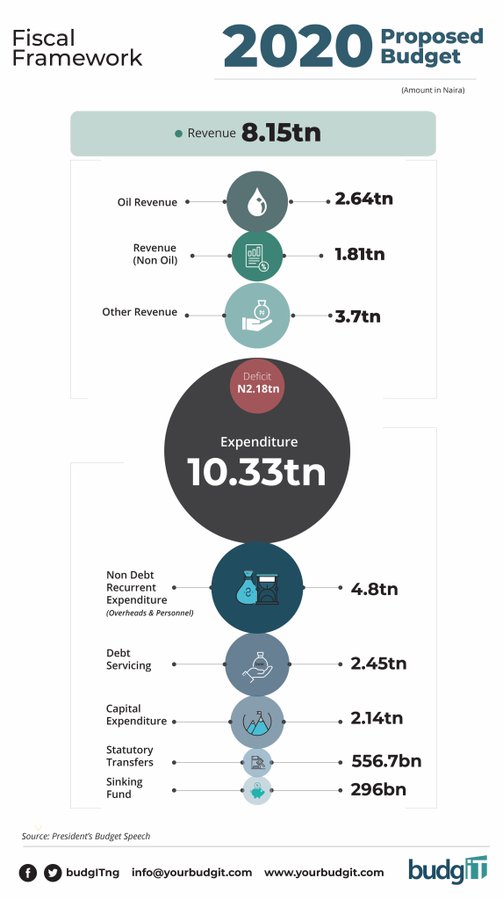
In 2018, N2.15trn was spent servicing debt and a similar amount has been earmarked for 2019. For 2020, N2.45trn is budgeted for servicing debt.
Beyond that, the cost of governance is also on a steady rise.
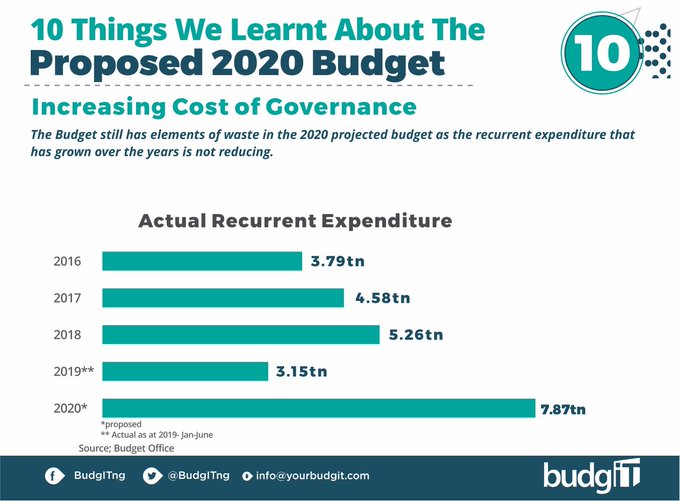
A breakdown by BudgIT, a frontline nonprofit advocating for transparency and fiscal accountability of governments across West Africa, shows that recurrent expenditure has increased year-on-year since 2016 and a record N7.8trn is budgeted for it in 2020.
In the 2020 proposed budget, the federal government has projected the sum of N2.45tn to service debt which is about 23.7% of the total expenditure. Nigeria now spends more debt servicing than capital expenditure.
10. The Budget still has elements of waste in the 2020 projected budget as the recurrent expenditure that has grown over the years is not reducing. However, several capital items in the budget are not specific neither are they needed considering the revenue crunch.
View image on Twitter
15 people are talking about this

Projected non-debt recurrent expenditure (overheads and personnel) for 2020, is N4.8trn.

President @MBuhari today presented to a joint session of @nassnigeria an Expenditure Budget of N10.33tn, with N8.15tn projected as revenue and deficit (borrowing) of N2.18tn.

We shall bring you more details.
View image on Twitter
126 people are talking about this

After winning re-election in February 2019, President Buhari announced a 43-man cabinet in August of the same year. Four years ago, he had reduced the overall number of ministers from 42 to 36 and streamlined the ministries to 25.
The members of the new cabinet supervise a largely redundant civil service which continues to accumulate salaries and hike the cost of salaries and overheads in the annual budget, on a yearly basis.

Bottom of Form

Civil servants, especially the retinue of government advisers, make up a bulk of the large delegations that accompany members of the executive at federal and state levels on a plethora of foreign trips. There are also frequent allegations of ‘ghost workers’ in the service, a term for nonexistent workers whose salaries go down on the balance sheet.
The Oronsaye report is an 800-page report submitted to Buhari’s predecessor, Goodluck Jonathan, by Stephen Oronsaye, a former head of the civil service and head of a committee constituted by the then-president to tackle civil service reforms. It called for a shrinkage of government, with as many as 102 parastatals and agencies recommended for scrapping. The report, which also called for an audit of selected government agencies, has never been implemented to this day.

Back in 1999, another committee with a similar mandate was established under the leadership of another former civil service head, Ahmed Joda. It made similar recommendations to both the Oransaye report and an earlier one – the Allison Ayida committee of 1995.

In what is hopefully an indication of more to come, Buhari ordered a forensic audit of the Niger Delta Development Commission (NDDC)‘s operations from 2001 to 2019. Established under the Olusegun Obasanjo administration to trigger development in the oil-rich region, the commission has for years had the reputation of a corrupt institution and is widely believed to have become a cash cow for funding elections in the Delta.
But that is only a drop in the ocean.
Why this is important: Talk of reducing the size and cost of governance has gone on in Nigeria’s corridors of power for decades but has remained just that – talk. There is no better time than now for Nigeria to walk the talk and prune its government and pinch the pennies to be able to deliver dividends of democracy to its citizens.


Thanks for reading. Follow the page and Share it.