Showing posts with label Xenophobia. Show all posts

Monday, May 11, 2020

Africans no longer wanted in China – Abike Dabiri-Arewa


Chairman of the Nigerian in Diaspora Commission, Abike Dabiri-Arewa, has alleged that Chinese want Africans out of their country.
Dabiri-Erewa made the claim while lamenting the alleged maltreatment of Nigerians in China.

She urged Nigerians in China to always demand for their rights.
Speaking during a town hall meeting of Nigerians in the United States, US, via zoom, over the weekend, Dabiri-Erewa said despite having many illegal Chinese migrants in Nigeria, none of them has been exposed to maltreatment.

The former lawmaker, however, assured that Nigerian government was making efforts towards addressing the situation.

She said: “The issue of China has been recurring and I have been to the Chinese Embassy a couple of times, putting into consideration what has been happening to Nigerians in China.

“I will be very realistic with the issue of Africans in China. What I am seeing is that they don’t want Africans in China.”

Dabiri-Erewa also called on Nigerians resident in China to obey the Chinese authority.

Appealing to them to stay out of trouble, Dabiri-Erewa called for peace and mutual respect in the world.

“It is still tough for Nigerians in China. Maltreatment is still going on and it has to be dealt with. Right now, there is a little of sanity, but we don’t know how long it will last, but there has to be a permanent solution to the issue of blacks being maltreated in China,” she added.


Thanks for reading. Follow the page and Share it.

Friday, October 18, 2019

Xenophobia isn't unique to South Africa

MIMI KALINDA

Refugees and asylum seekers protest in Cape Town, saying they would rather leave South Africa than face xenophobia. Picture: Sisonke Mlamla

Xenophobia is not a uniquely South African problem. Africa suffers from a broader plague of intolerance, misplaced nationalism and xenophobia which must be addressed to move the continent forward. There are countless examples of instances where we have blamed some of the most vulnerable people in our communities, often immigrants, for our economic challenges. 

In September 2019, South Africa held a mirror for all of us to look into, offering us an opportunity to be introspective. By refusing to look into this mirror and making xenophobia a South African issue alone, we avoid the opportunity for collective improvement and unity. The first week of September 2019 was a harrowing one. When the news of the xenophobic attacks in South Africa broke out, I received a number of messages from people on my social media platforms asking me why I wasn’t commenting publicly on the issue. 

I am a vocal champion of the African narrative and, I suppose, this would have been as good a time as any to say something to condemn what was happening in the country. I felt that I would be stating the obvious. Of course, it is wrong to use violence against anybody, including so-called foreigners. It goes without saying that anyone who justifies xenophobia, as many socio-economic reasons as there may be for South Africans’ frustrations with the challenges in their country, is justifying the utterly unacceptable. However, it would be hypocritical and short-sighted to drive the narrative that the “xenophobic” label belongs to South Africa alone.

I clearly remember when my family immigrated to South Africa after the political tensions between the Congolese and Rwandans exploded in the Democratic Republic of Congo (DRC) in the 1990’s and early 2000’s. Even before that, as my mother’s generation of Rwandans were coming of age in what was then known as Zaire, to be Rwandan was synonemous to being inferior and brought with it the little indignities that foreigners have to live with every day, which they end up normalising even in their own minds. They have often never known anything else. Seeing my family pack up and flee to Johannesburg from Kinshasa, where I was born and spent a great part of my childhood, was confusing for me- the tensions between Rwandans and Congolese people left me conflicted internally because my mother is Rwandan and my father is Congolese.

Fast forward to 2015 and I followed with great amusement when, in 2015, giant fashion brand Louis Vuitton launched the big, square, checked bags that came in blue and red which my grandmother used to take to the market when I was a little girl. These bags are fraught with a dark history and are popularly referred to as “Ghana Must Go” bags. The name was coined when Nigeria expelled two million undocumented West African migrants, half of whom were from Ghana. 

Those bags became the symbol of exclusion and intolerance. The rhetoric was the same as the one we have heard recently in South Africa- the Nigerian economy was failing following the oil crash, and the country turned inwards, blaming African migrants, especially Ghanaians. They claimed that Ghanaians had taken all the jobs and brought crime to the country. An eerily familiar narrative. Others argue that “Ghana Must Go” was retaliation from the 1960s when Nigerians were expelled from Ghana en masse following, again, economic depression.

In August 2019, it was reported that the Central African nation of Equatorial Guinea has put in place plans to erect a wall along its 183km-long border with Cameroon to keep Cameroonians out following a history of border friction between the two countries. Tensions have been rising between the central African neighbours since Equatorial Guinea discovered oil in the 1990s. Moves such as these are heavily taxing on any progress we make as Africans. Why are we so quick to think fellow Africans will deplete our resources? Where is this scarcity mentality coming from?

Painting South Africa and its people as xenophobes is dangerous to the aspirations of the entire continent. As we grapple with the practicalities of initiatives such as the African Continental Free Trade Agreement (AfCTA) and one African passport, we must take collective responsibility for the things that affect us as a continent, both positively and negatively. The positive political, economic and social changes that have taken place on the continent lately have been the result of a common effort and vision for a better Africa. 

We are driven by our historical experiences of what works and what doesn’t, fatigue for mediocrity and a deep-seated need to see change happen. We must exert the same energy in taking responsibility for and speaking about the negative things that continue to plague Africa, including intolerance of “the other”. To say that South Africans are xenophobic without having the larger continental debate exonerates the rest of us from taking a self-critical and introspective approach which acknowledges what we have historically done or are currently doing to immigrants in our own countries. This stands in the way of the development of our continent.

Lastly, the continued negative narrative about South Africa has serious implications for the country’s economy and its social fabric. Africa simply cannot afford to have a “broken” South Africa. We cannot have a South Africa which is not thriving. As a key economic power on the continent, South Africa plays a pivotal role in the Africa we would all like to see emerge. Ostracizing narratives about the country will only hurt us all. We need to be mindful of the stories we tell.

* Mimi Kalinda is the ACG Group CEO and co-founder. She is a leader in the field of PR and communications – both in Africa and globally. 


Thanks for reading. Follow the page and Share it.

Saturday, October 5, 2019

Xenophobic attacks in South Africa embarrassed continent: Nigeria's Buhari

Daniel Mumbere


An embarrassment for the continent

Nigeria’s president Muhammadu Buhari said on Friday that a wave of deadly violence against Nigerians and other foreign nationals in South Africa last month was an embarrassment to the continent.

In September, rioting and attacks on foreigners led to at least 10 deaths, dozens of injuries and hundreds of arrests, triggering anger at home and abroad.

“The recent acts of xenophobic attacks on our compatriots and other Africans in South Africa are shocking to me, Nigerians and indeed Africa. It was an embarrassment to the continent,” Buhari told a town hall meeting with Nigerians living in South Africa, according to details of his speech on the Nigeria presidency Twitter page.
As the government of South Africa, we have expressed our deep regret at the attacks directed at foreign nationals.

“As a government, we are quite disturbed by these very unfortunate events and have taken actions and measures to address this issue and prevent their reoccurrence with the South African government,” he added.

Following the attacks, Buhari ordered the immediate voluntary evacuation of all Nigerians wanting to return home and around 600 people were repatriated.

Buhari met South African President Cyril Ramaphosa on Thursday. They both regretted the violence and subsequent retaliation in Nigeria against South African businesses, pledging instead to deepen trade ties.

Buhari called for peace at the town hall meeting.

“The authorities have expressed their apologies over the incidents and have resolved to take necessary steps to end this ugly trend in the interest of our relationship,” he said.
“Let us therefore give peace a chance and pray we have seen the last of this ugly violence.”

Recalling the xenophobic fallout

In September, mobs armed with makeshift weapons attacked businesses and homes owned by foreigners, leading to at least 10 deaths, dozens of injuries and up to 400 arrests.
In response Nigeria repatriated around 600 of its citizens living in South Africa.

The local units of South African telecoms company MTN and supermarket chain Shoprite closed all stores and service centres in Nigeria after their premises were attacked by Nigerians protesting against attacks on their compatriots in South Africa.
#PMBinSA significant for a number of reasons:

- 2019 marks 20 years since establishment of SA-Nig BNC

- First State Visit to SA since new administration kicked off in May

- First Meeting of the “elevated” BNC (first time ever both Heads of State are co-chairing the BNC) pic.twitter.com/dpej9Mi9Vh
— tolu ogunlesi (@toluogunlesi) October 3, 2019

South Africa, Nigeria trade deals

South Africa and Nigeria signed 32 bilateral agreements and memoranda of understanding covering trade and industry, science and technology, defence, agriculture and energy.

One of key items on Nigerian Agenda here is the push for large® Nigerian companies to have more opportunities to invest/establish in South Africa. At the moment the reality is of an imbalance: while SA Cos in Nigeria are large Corporations, Nigerian Cos in SA tend to be SMEs.
— tolu ogunlesi (@toluogunlesi) October 3, 2019

Nigeria accounts for 64 percent of South Africa’s total trade with the West African Region and is one of its largest trading partners on the continent.

Buhari, Ramaphosa address xenophobia

Presidents Cyril Ramaphosa and Muhammadu Buhari, at the conclusion of a two-day visit by the Nigerian leader, said they regretted the violence and subsequent retaliation in Nigeria against South African businesses, pledging instead to deepen trade ties.

“As the government of South Africa, we have expressed our deep regret at the attacks directed at foreign nationals and our condemnation of all forms of intolerance and acts of violence,” Ramaphosa told journalists.

Buhari said beyond the economic partnership the anti-foreigner violence had to be addressed quickly.
“We decided to take concrete measures to prevent the recurrence of such unacceptable incidents in the future,” Buhari said.

Both countries have agreed to establish an Early Warning System / Mechanism to ensure that future potential outbreaks of violence are nipped in the bud before they degenerate. Identify tensions as soon as they emerge, alert each other, take steps to de-escalate. #PMBinSA pic.twitter.com/uh7rKWpPpV
— tolu ogunlesi (@toluogunlesi) October 3, 2019

Buhari leaves for South Africa

Nigeria’s president Muhammadu Buhari on Wednesday travelled to South Africa, to resolve the issue of the welfare of Nigerians.

In a statement posted by the Nigerian presidency on Tuesday, it was announced that Buhari would meet Nigerians living in South Africa, preside over the South Africa-Nigeria bi-National Commission and participate at a South Africa-Nigeria Business Forum.
Buhari’s visit follows a spate of xenophobic attacks in South Africans cities that targeted foreign nationals including Nigerians.

Both governments sent special envoys to manage the diplomatic fallouts from the attacks, even as Nigeria’s government organised evacuations of its nationals that were no longer at ease in South Africa.

‘‘Buhari will hold a town hall meeting with Nigerians living in the country, with a view to sharing in their experiences and reassuring them of Nigerian government’s commitment to working for the protection of their lives and property and promoting peaceful co-existence,’‘ read part of the statement.

The violence in South Africa had stoked concerns about relations between Africa’s two biggest economies.


Thanks for reading. Follow the page and Share it.

Friday, September 20, 2019

Xenophobia: Minister in the Presidency Mthembu on damage control

Minister in the Presidency, Jackson Mthembu / Photo: GCIS

It’s been a truly grim month for South Africa and for the ruling African National Congress (ANC). A tide of xenophobic violence, coupled with dire crime statistics and a spate of vicious femicides has left the country shell-shocked. President Cyril Ramaphosa has had his hands full, attempting to allay fears of a national crisis while still appeasing neighbouring countries.

Earlier this week, Ramaphosa announced his plan to reform judicial clauses pertaining to criminal acts of gender-based violence. The president has also deployed an inter-governmental task team to various African nations, with the hope of repairing diplomatic tensions.

On Thursday, Minister in the Presidency, Jackson Mthembu, confirmed that other African leaders would join the investigation. Former Tanzanian president, Jakaya Kikwete and Joachim Chissano, Mozambique’s former head of state have both been sent on a ‘fact finding mission’. Mthembu said:

“If you were to put a team only consisting of South Africans, will those who have been subjected to this violence, who come from other countries outside of our borders, be trustful of that team? That is one issue that we must think about.”


Thanks for reading. Follow the page and Share it.

Tuesday, September 17, 2019

South Africa apologises to Nigeria over xenophobic attacks

Share this with Facebook

A member of the Metropolitan Police watches a mob of rioters in Johannesburg earlier this month
GETTY IMAGES
Image captionSouth Africa has been rocked by a wave of unrest and xenophobic violence this month
Image copyright
South Africa has apologised to Nigeria over a spate of xenophobic attacks which led to a spike in tensions between the two countries.
Twelve people were killed earlier this month when mobs attacked foreign-owned businesses, mainly in Johannesburg.
A special envoy from South Africa presented an apology to Nigeria's President Muhammadu Buhari on Monday.
The envoy, Jeff Radebe, expressed the country's "sincerest apologies" at a meeting in the Nigerian capital, Abuja.
"The incident does not represent what we stand for," he said, adding that South African police would "leave no stone unturned" in bringing those involved to justice.
Mr Radebe also told President Buhari that the South African government condemned the violence and was taking decisive action.
Mr Buhari thanked Mr Radebe for "coming to explain to us what happened in South Africa recently, leading to [the] killing and displacement of foreigners".

'Ramaphosa's shame'

"President Buhari responded to profuse apologies from the South African president, pledging that the relationship between the two countries will be solidified," a statement from his office said.
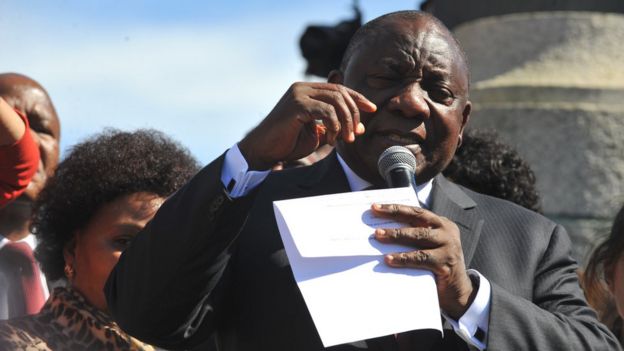
At the end of last week, South Africa's President Cyril Ramaphosa told the BBC that he felt ashamed by the recent violence.
"We are very concerned and of course as a nation we [are] ashamed because this goes against the ethos of what South Africa stands for," he said.
President Cyril Ramaphosa
GETTY IMAGES
Image captionSouth Africa's President Cyril Ramaphosa has said he feels ashamed by the violence
Image copyright
No Nigerians were killed in the violence in South Africa, but Nigerian-owned shops and businesses are believed to have been targeted by the mobs.
Of the 12 people who were killed, 10 are reported to have been South African nationals and two were from Zimbabwe.
Nigeria has been outspoken in its condemnation of the violence. A fortnight ago, it withdrew a delegation from a major international conference taking place in South Africa.
Tensions were inflamed after videos and images were shared on social media purporting to show Nigerians being attacked and killed. The Nigerian government said there was no evidence that this had taken place.
But it did say that Nigerian-owned businesses had been targeted.

The attacks started after lorry drivers staged a strike to protest against the employment of foreigners.
South Africa has become a magnet for migrants from other parts of Africa as it has one of the continent's biggest and most developed economies.

Evacuation of Nigerians

But there is also high unemployment in the country and some people feel foreigners are taking their jobs.
While the diplomatic mission is taking place, Nigeria has continued to evacuate its citizens from the country.
Last week, Nigeria's Consul General Godwin Adama said only those who were under distress as a result of the attacks would leave South Africa.
More than 300 Nigerians are expected to arrive in Lagos on Tuesday. Last week, 188 evacuees arrived back.

Thanks for reading. Follow the page and Share it.

Thursday, September 12, 2019

Nigerians leaving South Africa will have to wait another day for their flight

Ntwaagae Seleka

With travel bags in tow and their young children by their sides, Nigerians living in South Africa are desperate to return to their home country and have flocked to the offices of the Consul General of Nigeria in Illovo, Johannesburg on Thursday morning.
A man, among a first group of Nigerians repatriated from South Africa following xenophobic violence, sits with others after arriving in Lagos, on September 11, 2019.

By 07:00, the place was buzzing as a number of Nigerians stood in a queue, wanting to leave South Africa following violent unrest that ravaged parts of Gauteng over the past two weeks. It was their second day there.
At least 12 lives were lost during the violence in the province.
During a briefing in Cape Town on Tuesday, Defence Minister Nosiviwe Mapisa-Nqakula said 10 of the 12 people who were killed were South African
Some Nigerians told said that they arrived very early in the morning to be first in the queue, hoping that the offer of free flights home would finally materialise and the flight would depart from OR Tambo International Airport.
The flights, which were supposed to leave on Thursday, have now been postponed to Friday, they were told.
Some Nigerian nationals said that they were even prepared to sleep outside the offices of the Consul General of Nigeria until they were ferried to the airport on Friday.
"It is just a single day left. I can't wait to leave this country. I want to return home alive - not in a coffin," said Solomon Michael.
Michael arrived in South Africa a year ago to pursue his soccer career.
However, after undergoing several trials at various professional teams, he was unsuccessful and ended up opening a hair salon in Cosmo City.
"People in Cosmo City welcomed and accepted me with warm hands. I was living freely with them until xenophobic attacks flared up. Fearing for my life, I packed my bags and came here with my documents to go back home. I have left my business with my brother.
"Our parents back in Nigeria are worried about our safety and they have been calling us, pleading with us to return home. I believe that the grass will be greener back home and hopefully, there will be a soccer team that will sign [a contract with] me," he said.
Promised heaven and earth
Noimot Babatunde claimed she was lured to South Africa five years ago, by a fellow Nigerian who promised her heaven and earth.
Upon arrival in Durban, she realised that she had been lied to and was forced to find employment as a domestic worker. 
Babatunde travelled by bus from Durban to Johannesburg to catch a flight back home.
She said a policewoman from Durban have her the bus fare because she was concerned about her safety in South Africa.
"That man lied to me saying he was owning companies in Durban and promised to employ me and pay a big salary. When I arrived here, things were different. He didn't even own businesses as he claimed. He took my passport and wanted to own me. I managed to escape and alerted Durban police officers who arrested him and retrieved my passport.
"The man has since been deported back to Nigeria. I then met a South African man from Durban who impregnated me. My ex-lover hates me and doesn't want anything to do with our daughter, Andiswa. Today, our daughter doesn't have a South African birth certificate, except for a proof of birth document I obtained from the hospital when she was born in 2017," she said.
Babatunde wants to go back home and start life afresh with her daughter.
"I came here thinking things will be rosy. Now, I am going back with a child that doesn't have a father. My parents in Nigeria are aware of my situation and are praying for my safe return with Andiswa," she said.
Blessing Emmanuel said she was eager to return home and reunite with her two daughters. She last saw them in 2012.
"I came here in 2009 with my husband who was killed in 2012 by robbers in Johannesburg. Since his death, I have been running a small restaurant in the Johannesburg CBD. My shop was attacked and looted two weeks ago. They set it alight and took everything, including my clothes.
"I am temporarily staying with a Nigerian couple who have given me shelter, food and clothing. I want to go home and spend time with my children. I will rather die back home than to be killed by angry people who hate their fellow black people over nothing. South Africa has been turned into a violent country where life is worth nothing," she said. 

Emmanuel said she had been given 620 Naira to spend for transport and food when she lands in Nigeria.

Thanks for reading. Follow the page and Share it.

Tuesday, September 10, 2019

South Africa: Nigeria to repatriate 600 citizens amid violence


Last week's wave of violence in Johannesburg left at least 10 dead

Nigeria says it will repatriate some 600 citizens from South Africa after a wave of xenophobic violence which led to tensions between the two countries.
Some will leave on two flights on Wednesday, Nigeria's Consul General in Johannesburg told the BBC.
Ten people, including two foreigners, were killed in the city last week when mobs attacked foreign-owned businesses.
The attacks started after lorry drivers staged a strike to protest against the employment of foreigners.
South Africa has become a magnet for migrants from other parts of Africa as it has one of the continent's biggest and most developed economies.
But there is also high unemployment in the country and some people feel foreigners are taking their jobs.
Nigeria's Consul General Godwin Adama said only those who were under distress as a result of the attacks would leave the country.
Meanwhile, Abike Dabiri, head of the Nigerians in Diaspora Commission, said the government would not provide financial assistance to those leaving South Africa.
Speaking to journalists in Abuja, she said the Nigerian government would continue to hold the South African authorities accountable and insist it paid compensation to its citizens.

More violence on Sunday

On Sunday, two people were killed as violence erupted in Johannesburg after a speech by Mangosuthu Buthelezi, a former leader of the opposition Inkatha Freedom Party and minister in the country's unity government after the end of apartheid.
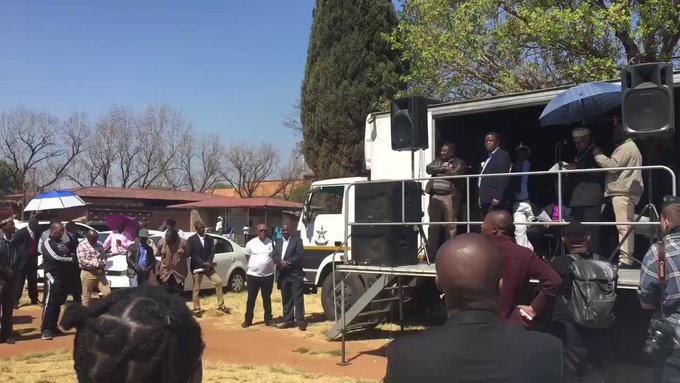
Mr Buthelezi, who was trying to quell tensions over xenophobia, was heckled by a rowdy section of the crowd who later clashed with security forces. Video shared on Twitter showed people walking out of the meeting.


People then targeted cars and buildings, which were set alight, Johannesburg Metro Police Department chief David Tembe told Eyewitness News, saying it was "pure criminality" as some of the shops attacked belonged to South Africans.
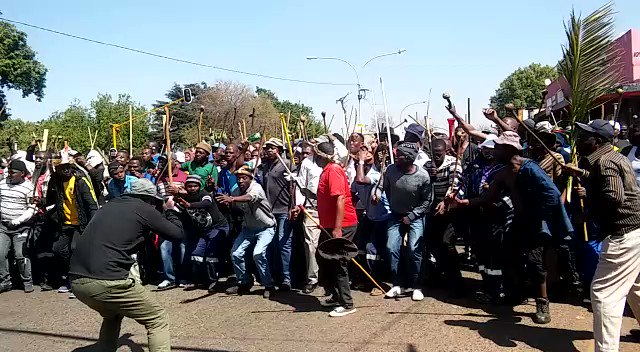
Earlier, dozens of men carrying clubs marched in the city singing "foreigners must go back to where they came from", Soweten Live reported. The crowd headed to Jules Park in Johannesburg where Mr Buthelezi was due to make his address.


President Cyril Ramaphosa condemned the violence, saying the authorities would "not allow sporadic lawlessness and violence to disrupt the safety and livelihoods of millions of South Africans".
He added that "the majority of foreign nationals in our country... are law-abiding and have the right to conduct their lives and businesses in peace".
Nigerian President Muhammadu Buhari sent an envoy to South Africa last week to "express Nigeria's displeasure over the treatment of her citizens".
In a statement, the president's office said the envoy had "stressed the need for [the] South African government to take visible measures to stop violence against citizens of brotherly African nations".
President Ramaphosa "agreed that the violence was most disconcerting and embarrassing," the statement added.

As the week progressed, people across the continent shared videos on WhatsApp which purported to show violent attacks on Nigerians. But these were denounced as being misleading.

Thanks for reading. Follow the page and Share it.