Showing posts with label Inequality. Show all posts

Monday, November 18, 2019

South Africa’s income inequality is particularly uneven


MWANGI GITHAHU

Inequality in South Africa persists because poor people migrate to wealthier parts of the country in search of opportunities. File Picture: Henk Kruger/African News Agency (ANA)


Cape Town - Inequality in South Africa persists because poor people migrate to wealthier parts of the country in search of opportunities.

This is the view of economist Dawie Roodt on the reasons provinces such as the Western Cape and Gauteng are always cited in studies on inequality as the two most unequal provinces in the country.
“The Western Cape is a very interesting case. It is the second richest province after Gauteng and it also attracts the most immigrants from within the country, particularly the Eastern Cape. The more poor people come to the province in search of opportunities, the more inequality will increase and that is the irony,” said Roodt.

“The poor won’t go to Limpopo for instance, because it is poor, but going to a rich province improves their chances, while at the same time widening the inequality gap.”

Income inequality means that a few make much more money in a society than most others. South Africa’s income inequality is particularly uneven, with a few high earners getting huge incomes while the large poor majority’s income is dismally low.

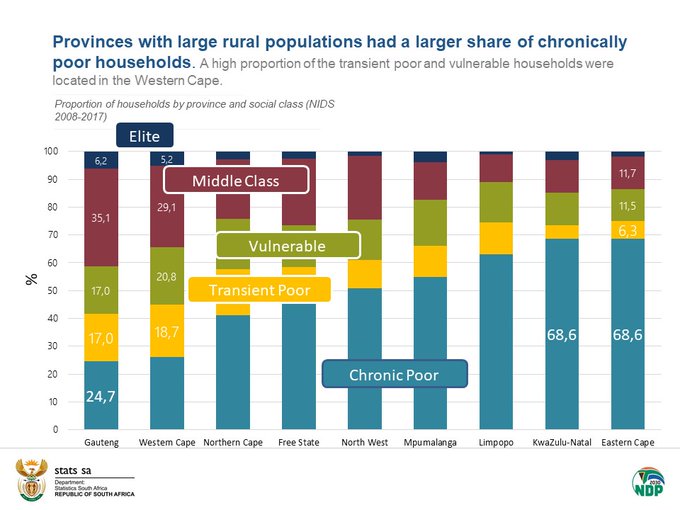
According to the Statistics SA inequality trends report released last week: “Provinces with large rural populations had a larger share of chronically poor households and a high proportion of the transient poor and vulnerable households were located in the Western Cape.”
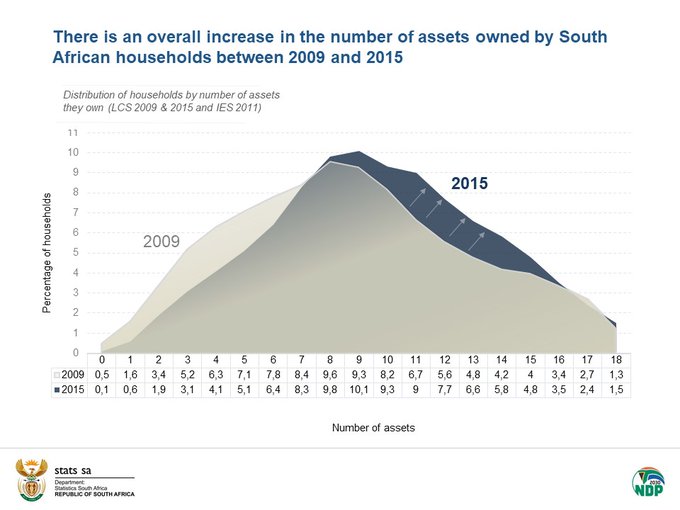
There is an overall increase in the number of assets owned by South African households between 2009 and 2015.

Read more here: https://bit.ly/2QimvSL  @ARUA_ACEIR @SALDRU1 @AFD_en @EU_Commission
View image on Twitter
Provinces with large rural populations had a larger share of chronically poor households. A high proportion of the transient poor & vulnerable households were located in Western Cape.

Read more here: https://bit.ly/2QimvSL  @ARUA_ACEIR @SALDRU1
View image on Twitter
25 people are talking about this
On average, females earned less than males across all educational levels. Females with no education and primary education earned roughly 55% of what males in the same groups earned.

Black African- and coloured-headed households were the only two groups classified as chronically poor, with black African-headed households having the lowest levels of access to the internet and the lowest access to medical aid coverage.

“South Africa’s labour market remains of primary importance in understanding contemporary inequality in the country. With an overall unemployment rate that ranges between 25% and 30% using the official (narrow) definition, any empirical investigation into economic inequality in South Africa would be incomplete without an analysis of the labour market,” the report said.

Statistician-General Risenga Maluleke said South Africa stood out as one of the most unequal countries in the world by most inequality measures.

“There is growing recognition that persistently high levels of inequality can have serious detrimental effects on a society and its economy. For all of these reasons, it becomes clear why reducing inequality is such a critical task from a policy perspective,” said Maluleke.

The impact of apartheid policies has left a legacy of unequal development across the South African landscape, manifesting in regional inequalities in terms of access to education, health care, and basic services (such as water, sanitation, refuse removal and electricity). Since democracy in 1994, the government has tried to eliminate these inequalities with varying degrees of success.

Overall, when examining progress at a national level there appears to be notable areas of success and improvement. Nevertheless, when examining this progress at lower disaggregations, the story becomes mixed as there still are clearly some groups and/or places that lag behind others in terms of access.


Thanks for reading. Follow the page and Share it.

Thursday, November 7, 2019

More than 52 million people across Africa going hungry as weather extremes hit the continent

Millions displaced; women, girls hit hardest; crises compounded by conflicts, poverty and inequality; $700m average climate-related losses; urgent action needed now


More than 52 million people in 18 countries across southern, eastern and central Africa are facing up to crisis levels of hunger as a result of weather extremes, compounded by poverty and conflict.

Some areas are facing a second extreme drought in four years and worse than that sparked by El Nino in 1981.

In the South, parts of Zimbabwe have had their lowest rainfall since 1981 which has helped push more than 5.5m people into extreme food insecurity. Zambia’s rich maize-growing area has been decimated and exports are now banned; 2.3m people there are food insecure. The situation is worsening including in Angola, Malawi, Mozambique, Madagascar, Namibia and Zimbabwe. There are reports of farmer suicides in South Africa.

Drought has also hit the East and Horn of Africa particularly Ethiopia, Kenya and Somalia. At the same time, record-breaking temperatures in the Indian Ocean have dumped ultra-heavy rainfalls into Kenya and South Sudan, causing flash-flooding especially along major river arteries. South Sudan has declared a state of emergency with more than 900,000 people hit by floods.

In Africa extreme weather events have hit many countries already suffering from ongoing conflict. Across the continent, 7.6 million people were displaced by conflict in the first six months of 2019, and another 2.6 million by extreme weather. In the Horn, Ethiopia, Somalia, South Sudan and Sudan have simultaneously faced over 750 000 people displaced by conflict and 350 000 displaced by extreme weather.
Scientists have demonstrated how climate change is increasing the frequency or severity of many extreme weather events. Over the last decade, these 18 African countries have collectively suffered average annual losses of $700m from climate-related disasters– and this is without counting the cost of these latest crises, says Oxfam. However, there has been minimal progress globally in raising funds specifically to address loss and damage from climate change. Africa contributes less than 5% of total global emissions but is suffering some of the most severe impacts of the climate crisis.

Officials will meet at the African Ministerial Conference on the Environment (AMCEN) in Durban Nov 11-15 to discuss the future of Africa’s “environmental sustainability and prosperity”. Oxfam urges ministers to demand that industrial nations honour their promises to avoid escalating human and financial costs and to pay for damages.

“We are witnessing millions of already poor people facing extreme food insecurity and exhausting their reserves because of compounding climate shocks that hit already vulnerable communities hardest. They need help urgently. The scale of the drought devastation across southern Africa is staggering,” said Oxfam’s Southern Africa Regional Director Nellie Nyang'wa.

“In western Kenya, the crop harvest is 25% down and in parts of Somalia up to 60%. Livestock in many rural areas are emaciated and milk production is down. Cereal prices in some areas have rocketed up to five-year highs, pricing out poorer people. Nearly 7m people in the region are living just below the catastrophic hunger line,” said Oxfam’s Horn, East and Central Africa regional director Lydia Zigomo. “It is a vicious cycle where poor and marginalized communities, mostly women and girls, are more exposed to the climate crisis and less able to cope and recover from its harm.”.

Mithika Mwenda, chief executive of Oxfam’s partner PACJA, said “communities at the frontline of this climate crisis are overstretched and may be facing potential annihilation. But local people are doing everything that can to overcome the challenge. There are unprecedented levels of organization happening where governments have let local people down.”

“We’re seeing people trying to cope with shifting seasons and erratic rainfall by finding new ways to make a living off-farm. Women are coming together to pool their resources through small internal lending communities, buying food together, growing sweet potatoes instead of maize – all without outside support. Local people have the solutions but what they lack is resources, especially funding.

“Our leaders should look to support these community solutions to build up people’s resilience to climate change. For 35 years AMCEN has been a very important platform with impactful policies that have helped to create awareness of environmental sustainability. It needs to move away now from policy making to policy implementation.”

Oxfam is currently reaching more than 7 million people in ten of the hardest hit countries with food and water support, and long-term development projects to help people cope better with climate-related shocks. Oxfam plans to reach 10% of those most in need in these ten countries and is trying to raise $65m to do so.
Oxfam is calling on African ministers at the AMCEN meeting to:
• Insist rich industrialised countries decrease their CO2 emissions in line with the Paris Agreement's goal of limiting global heating to below 1.5C, and honour their commitment to mobilise $100bn a year by 2020 to fund climate change adaptation and mitigation efforts in developing countries;
• Demand governments agree to develop a new funding mechanism for “loss and damage” from climate change at the upcoming UN climate conference (COP25);
• Invest more into universal, high-quality and gender-responsive public services and strengthen tax systems in African countries to close the gap between rich and poor;
• Improve their disaster warning and management systems, and commit to re-greening and agricultural policies that target women and men small-scale farmers;
• Invest in “social accountability” projects that ensures climate finance can reach the communities that need it most, and empowering them in their own decision-making
• Engage women and girls in the planning, design and implementation of early warning systems and climate mitigation and adaptation programs
• Protect people who are forced to move so that they are able to do so in safety, dignity and on their own terms.

Thanks for reading. Follow the page and Share it.

Thursday, September 12, 2019

Viral Inequality? The 3 Richest Africans Have More Wealth Than Half The Entire People On The Continent

By 

The Gap Between Africa’s Richest And Poorest Grows Wider
The three richest people in Africa collectively have more wealth than the poorest 650 million people across the continent.
In other words, the combined wealth of Nigeria’s Aliko Dangote, and the South African duo of Nicky Oppenheimer and Johann Rupert, is way more than what 50 percent of the poorest people on the African continent enjoy.
This detail was the highlight of a new report released by Oxfam International on Tuesday as part of preparations for the ongoing World Economic Forum (WEF) on Africa event which kicked off in Cape Town, South Africa, yesterday.
The report titled, “A Tale of Two Continents”, highlighted how rising and extreme inequality across Africa is undermining efforts to fight poverty. It showed the contrasting fortunes of the African elite and the masses who are stuck in privations.
A Tale of Two Continents really did find “two continents” in Africa; one for the richest Africans with fortunes that are only increasing, and another for the poorest Africans who are only plunging deeper into poverty.
The Oxfam report also looks at how unsustainable levels of debt and a rigged international tax system are depriving African governments of billions of dollars in lost revenue each year – money that could otherwise be invested in education, healthcare, and social protection.
Africa On The Brink Of A Poverty Pandemic
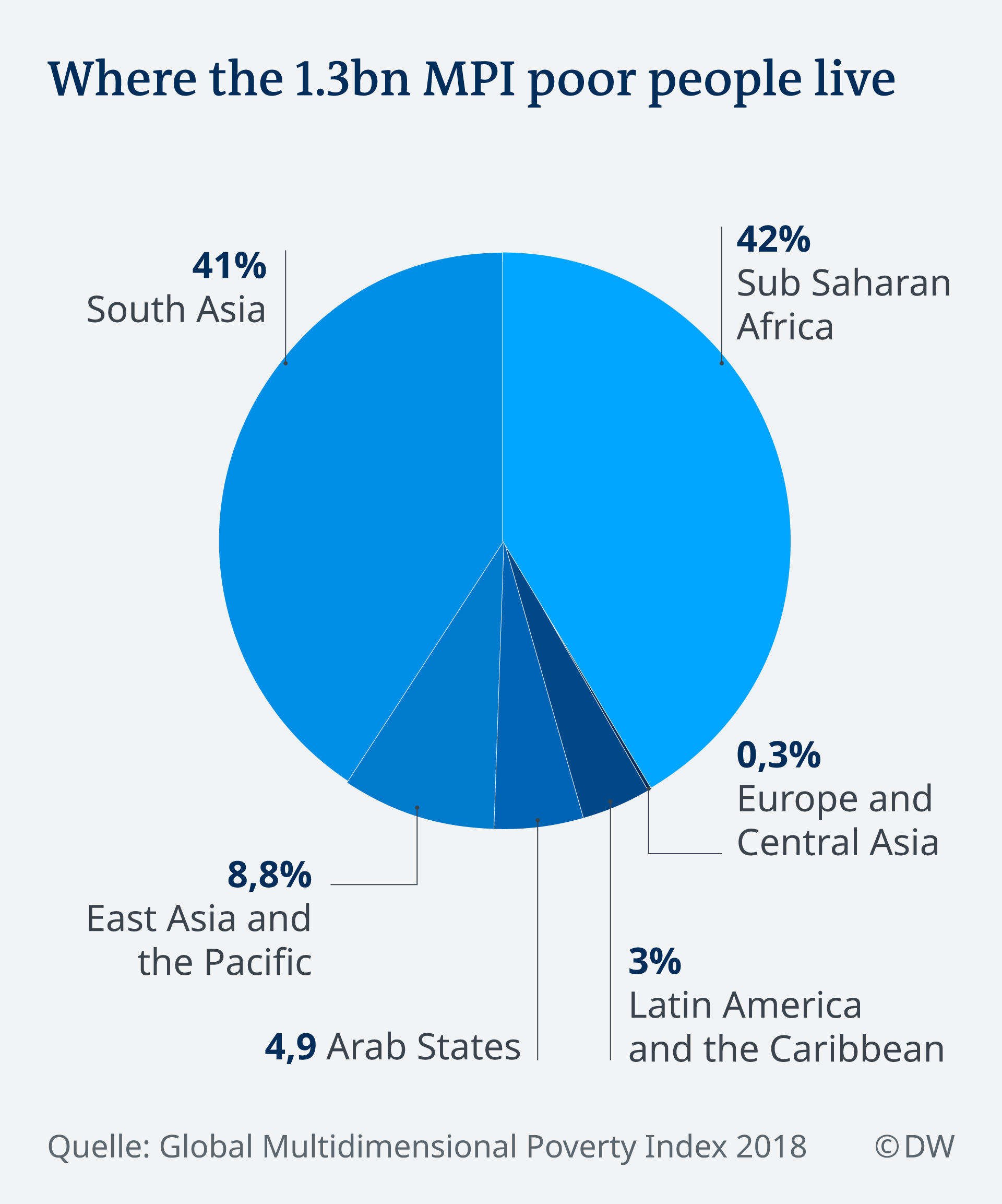
As it is, the African continent is heading for a precarious situation that could see it become the breeding ground for global extreme poverty. Asia used to be the region worst hit by extreme poverty. But as the number of people living on less than USD 1.90 a day has reduced significantly in the region, Africa has become the unfortunate torchbearer as poverty continues to rise.
Related image
Source: dw.com
It’s so bad that estimates from the World Bank have it that 87 percent of the world’s poorest people will be in Africa by 2030, and that’s if current trends continue.
“Africa is ready to rise – but only once it’s leaders have the courage to back a more human economy that works for the many and not a few super-rich men,” Winnie Byanyima, Executive Director of Oxfam International, said in the report. 
“They can achieve this by investing in inequality-busting, universal and quality public services like health and education and by developing truly progressive tax systems.”
South Africa, Namibia Doing The Most. Nigeria Scraping The Bottom.
In the report, Oxfam also included its first-ever ranking of African nations on their commitment to tackling inequality. 
The “Commitment to Reducing Inequality Index”, as it is called was developed by Oxfam and Development Finance International.
In this new index, countries are ranked based on their policies on social spending, tax, and labor rights – three areas both organisations find critical to reducing inequality.
In this regard, South Africa and Namibia come first and second respectively, with their strong social spending and a progressive tax system. Nigeria, meanwhile, has an unenviable distinction of being at the bottom of the Africa ranking, as well as the global ranking for the second year running.
Other Interesting Finds
Oxfam’s report revealed that the three richest African billionaires now have more wealth than the poorest 50% (or 650 million people) across the continent. Here are some other thought-provoking revelations:
  • The most unequal country in the region, Swaziland, is home to one billionaire, Nathan Kirsh, with an estimated net worth of USD 4.9 Bn. If he worked in one of the restaurants that his wholesale company supplies on a worker’s minimum wage, he would need 5.7 million years to amass his current wealth.
  • The combined wealth of the 5 richest people in Nigeria is more than enough to end poverty in Nigeria.
  • About 75 percent of the wealth of African multi-millionaires and billionaires is held offshore. As a result, the continent is losing up to USD 14 Bn annually in uncollected tax revenue.
  • Social spending is being hampered by dangerous and unsustainable levels of debt. In 2018, Angola spent 57 percent of government revenue on debt repayments while public spending was cut by 19 percent between 2016 and 2018. Similar trends are found in Egypt, Mozambique, Cameroon, and Ghana.
  • African women and girls are also most likely to be poor. They also stand to lose the most when public services like healthcare and education are underfunded. As an example, Nigeria’s girl population makes up 60 percent of the more than 10 million children who do not go to school.
Thanks for reading. Follow the page and Share it.