Monday, July 13, 2020

COVID-19: World’s 1st vaccine trial successful.


Russia has successfully carried out a human trial of COVID-19 vaccine.


Vadim Tarasov, the Director of the Institute for Translational Medicine and Biotechnology, said the world’s first COVID-19 vaccine test was carried out by the Sechenov First Moscow State Medical University.

Speaking with the country’s media platform, Sputnik, Tarasov said the vaccine was produced by Gamalei Institute of Epidemiology and Microbiology on 18 June.


Tarasov also disclosed that the first set of volunteers would be discharged on Wednesday while the second batch would be on July 20.

“Sechenov University has successfully completed tests on volunteers of the world’s first vaccine against coronavirus”, Tarasov said.


Thanks for reading. Follow the page and Share it.

Ghana reports nearly 700 new coronavirus cases


No deaths reported over past day, says Ghana Health Services


By Sena Guler


Ghana reported 692 new coronavirus cases over the past day, bringing the country’s total to 24,518, local authorities said Sunday.

Ghana Health Services said in a statement that over 327,000 tests have been conducted so far to diagnose COVID-19.

A total of 129 people have died from the virus while 20,187 people have recovered.

No virus deaths were reported over the past 24 hours, the statement said.

Ghana’s capital Accra along with Ashanti and the Western and Central regions have the highest number of cases.

The number of confirmed coronavirus cases in Africa now totals over 597,000 and 13,265 people have died.


Thanks for reading. Follow the page and Share it.

Chinese firm's upgrade of Tanzania's largest port set to bolster handling capacity


DAR ES SALAAM: Large vessels from across the world will soon be able to anchor in Tanzania's largest Dar es Salaam Port following upgrades undertaken by China Harbour Engineering Company (CHEC).


In July 2017, Tanzanian President John Magufuli officially launched the project to upgrade the east African nation's largest port, which mainly involves the upgrade of seven existing berths and the building of a new berth.


The upgrade will enable large vessels with a load carrying capacity of up to 70,000 tonnes to dock at the port, while currently the port accommodates vessels with a capacity of under 30,000 tonnes, said Wallace Rugalema, a site engineer for CHEC, who has high expectations for the ongoing project.


"The upgrade of the Dar es Salaam Port by the CHEC will definitely boost the port's handling capacity of cargo from across the world," said Rugalema, adding that the upgrade project also deepens the anchorage and strengthens the yard at the port.


Feasibility report for the project shows that the port's cargo handling capacity will be increased to about 17.65 million tonnes per year upon completion of the upgrade, a 26-percent increase over the current capacity.


Last year, Tanzanian Foreign Minister Palamagamba Kabudi said the expansion of the Dar es Salaam Port is a vivid example of Tanzania's participation in the China-proposed Belt and Road Initiative, adding that the country is committed to unlocking the potential of interlinked production networks and value chains that are enshrined in the initiative.


According to the Tanzania Ports Authority (TPA), the Dar es Salaam Port handles about 95 percent of the country's international trade and serves the neighboring landlocked countries like Malawi, Zambia, Burundi, Rwanda and Uganda.


The port is strategically placed to serve as a convenient freight linkage not only to and from East and Central African countries but also to the Middle and Far East, Europe, Australia and America, the TPA said.

For Tanzanian workers on the project site, upgrading their country's largest part is an opportunity to update their own skills.


Rugalema said that Tanzanian engineers and trainees working on the project benefit from the technical know-how provided by their Chinese colleagues.


Edwine Christopher, the CHEC human resources officer, said that the project, 80 percent of which has been completed, provided jobs to 900 Tanzanians.


Asked how the COVID-19 outbreak impacted the project, Christopher said that CHEC management observed all prevention and protection guidelines provided by health authorities to ensure employee safety.

"The guidelines included hand washing, wearing of face masks and social distancing," said Christopher, adding that "luckily all employees are safe to date." 


Thanks for reading. Follow the page and Share it.

Coronavirus: South Africa put a ban on alcohol sales for the second time to combat Covid-19


South Africa has introduced new restrictions, including another ban on alcohol sales, to help contain the spread of coronavirus.

A night-time curfew has been imposed, and the wearing of masks outdoors is now compulsory.

President Cyril Ramaphosa said the alcohol ban - South Africa's second this year - would take pressure off the national healthcare system.


It comes as total infections exceed a quarter of a million. 

Deaths resulting from coronavirus have also risen to more than 4,000, and government projections estimate this could rise to 50,000 by the end of the year.


South Africa remains the hardest-hit country on the continent, and earlier this week recorded its highest-ever single-day increase in cases. Nearly half of them were in Gauteng, a province that's become the outbreak epicentre.


In a public address, Mr Ramaphosa acknowledged "most" people had taken action to help prevent the spread, but he said there were still some who acted "without any responsibility to respect and protect each other".


"There are a number of people who have taken to organising parties, who have drinking sprees, and some who walk around crowded spaces without wearing masks," said the president.


Mr Ramaphosa said the new measures were being introduced to help the country to weather the storm of coronavirus, and a state of emergency would be extended until 15 August. The night-time ban would be in place from 21:00 to 04:00. 


The government has also made 28,000 hospital beds available for Covid-19 patients. But President Ramaphosa said the country still faced a "serious" shortage of more than 12,000 healthcare workers, including nurses, doctors and physiotherapists.


The alcohol ban comes just weeks after another three-month ban was lifted in an effort to prevent drunken fighting, cut domestic violence and eliminate weekend binge-drinking prevalent across South Africa. 

Doctors and police say the previous ban contributed to a sharp drop in emergency admissions to hospital. But the country's brewers and wine makers complained they were being driven out of business.


Thanks for reading. Follow the page and Share it.

Sunday, July 12, 2020

US breaks record with 66,000 coronavirus cases in one day


The coronavirus pandemic continues to ravage the United States of America.


The country at the weekend recorded 66,600 fresh infections in one day.


This was contained in Saturday’s data from Johns Hopkins University.

America broke its own record in three out of the last four days.

The state of Georgia smashed its own record, with more than 4,000 new cases.


The state of Florida reported more than 10,000 daily cases and 93 new deaths, Dpa reports.


Governor Ron De Santis opposed views that he pushed for reopening too quickly.


De Santis has said he would not be imposing a mandatory mask requirement state-wide.


On Saturday, President Donald Trump surprised the world when he visited a military hospital with a face mask, the first time in public.

As of Sunday morning, casualties in the U.S. had hit 137,000 with more than 3.3 million cases.


Thanks for reading. Follow the page and Share it.

Saturday, July 11, 2020

Kenyan students in US ponder next move after order to leave


They will be forced to leave the US or transfer to other colleges if online classes are offered entirely.


International students, among them hundreds of Kenyans currently in the US, are scrambling to figure out what next a week after America’s Immigration and Customs Enforcement (ICE) rolled out new guidelines stating that those whose institutions were only offering online classes would be required to leave the country.


ICE and the Student and Exchange Visitor Program also say new student visas won’t be granted for online-only instruction. The agencies cited the Covid-19 pandemic in making the changes.


“This rule has brought a lot of anxiety and fear among us Kenyan international students in the US. The directive is not even clear and so there’s just uncertainty and we don’t know what to do,” said Mordecai Njoroge, a Kenyan-born student at Cornerstone University in Michigan.


Mr Njoroge is one of an estimated 3,451 Kenyan students enrolled in US institutions of higher learning in the 2018- 2019 academic year, who could be affected by the changes.


The new guidelines from ICE state that international students would be forced to leave the US or transfer to other colleges if their schools entirely offer classes online this fall.


This rule came as a shocker to many colleges, students, and professors with most big universities and colleges scrambling to go to court to stop it.


“I have been receiving a lot of phone calls from my students in New York asking to know what this exactly means to them. Many are feeling that they are being unfairly punished because the university does not offer face-to-face classes for the Fall because of unprecedented Covid-19 pandemic conditions beyond their control,” Said Prof David Monda, a lecturer at City University of New York (CUNY)


He noted that poorly thought out policy of US immigration has thrown the educational plans of many foreign students into disarray. They could lose their scholarships and get deported for being out of status. In addition, Prof Monda said, many students are themselves parents which poses the real challenge of separating families.


“To me, this appears to be a blatant political ploy from the Trump Administration to gain cheap political points on immigration for the November election. It is also a way to force institutions of higher learning to open face-to-face classes prematurely. I'm sure it will become immediately challenged in court. Harvard University and MIT have already begun proceedings,” he added.


ANXIETY


Prof Jerono Rotich, founder and CEO of Kenya Students in Diaspora (KESID) Foundation said majority of international students are grappling with this new development that they are now living in heightened fear, anxiety and uncertainty in the midst of the pandemic.

She says the announcement has sparked immediate and intense confusion and is likely to disrupt normal semester activities.


“The unsettling feeling for most of these students is the thought of abandoning studies, the uncertainties of their health especially in airports if they have to travel back home given the recent cases of a majority of airline workers contracting Covid-19 and most succumbing to it,” she said.


Prof Rotich said this move, ignores the preparation, plans and investment international students had in place for the remainder of the year.


“Literally, it throws them under the bus! Bypassing years of tumultuous pain and the sacrifice (financial and emotional) international students go through to get to the US for better education. Given that most came to the US for quality education, it raises more questions than answers on the future of international students in the US. If a looming pandemic can threaten the place of the international students in the US, then it raises doubts for anyone planning to enrol for future education in the US,” she added.


BIG QUESTION


Mr Njoroge wondered what had changed to make the Trump administration resort to such extreme measures given that earlier this year, the Department of Homeland Security had given some flexibility for the students by allowing most of us to end the semester online.

Mr Njoroge noted many colleges have plans to institute hybrid classes that entail online and face-to-face interactions.


“The biggest question now is what implications will this have on our studies in the short and long term? What happens when schools start physical lessons and potentially go online again due to the potential second wave,” he wondered.


[DailyNations]

Thanks for reading. Follow the page and Share it.

Tanzania’s ruling party nominates president to run again


DODOMA, Tanzania (AP) — Tanzania’s ruling party on Saturday nominated President John Magufuli to run for a second five-year term, while opposition parties and human rights groups demand an independent electoral body to oversee the October vote.


The unanimous decision by the Chama cha Mapinduzi party to back Magufuli came as no surprise. 


The president, nicknamed “The Bulldozer” for his relentless work ethic and populist approach, has unsettled critics and some in the international community as his government clamps down on opposition gatherings, arrests opposition leaders and punishes dissent.

His administration’s approach to the coronavirus pandemic — not announcing case numbers since April, questioning face masks and declaring COVID-19 defeated — has caused further alarm.


Former President Ali Hassan Mwinyi and members of the ruling party have urged Magufuli to try to stay in power after 2025 despite Tanzania’s two-term limit. But he has said he won’t seek an extension after two terms.


Opposition parties have not declared their official candidate, and they have expressed skepticism with the electoral commission, demanding amendments to ensure the upcoming vote is free and fair.


Ruling party secretary-general Bashiru Ali told the gathering that the National Executive Committee nominated Magufuli because of his commitment to social and economic development and fighting corruption.


Magufuli said he was surprised by the support. “I never imagined I could get 100%,” he said. “This, however, should not mean winning the election by 100% as we have more work to do as a party.”


Thanks for reading. Follow the page and Share it.

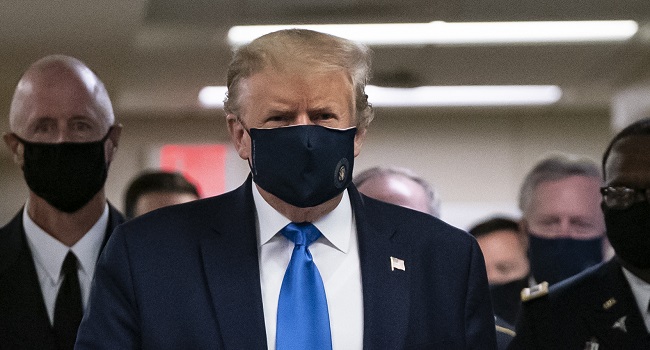
Trump Seen Putting Facemask In Public For First Time


US President Donald Trump wears a mask as he visits Walter Reed National Military Medical Center in Bethesda, Maryland’ on July 11, 2020. (Photo by ALEX EDELMAN / AFP)


US President Donald Trump wore a facemask in public for the first time Saturday, yielding to intense pressure to set a public health example as the coronavirus rampages across America.

Trump had on a black mask as he walked through the corridors of Walter Reed military hospital outside Washington to meet with wounded veterans, according to television news footage.


Trump strode past reporters and did not stop to speak to them about what had become a hotly anticipated moment — would he have a change of heart on a practice recommended by the government’s own medical experts, even as he resisted?


“I’ve never been against masks but I do believe they have a time and a place,” Trump said as he left the White House.


News reports this week said aides practically begged the president to relent and wear a mask in public — and let himself be photographed — as coronavirus cases soar in some states and as Trump trails Democrat Joe Biden badly in polls ahead of the November election.

Trump has steadfastly defended his administration’s handling of the pandemic even though the US is the hardest-hit country in the world.

The country has recently seen several days of more than 60,000 new cases, nearly 135,000 people have died and states have been left to figure out on their own how to reopen without a clear and coherent strategy from the White House.


Masks ‘a great thing’


To wear a mask or not has become a sort of political fulcrum for a deeply divided America.


Conservatives who back Trump often refuse to don one on grounds it impinges on their freedom, while progressives tend to back the practice as a show of collective responsibility at a time of a life-or-death crisis.

The US Centers for Disease Control and Prevention recommend people wear masks in public when they cannot engage in social distancing.


But Trump — at political rallies, media briefings and elsewhere — has repeatedly avoided wearing a mask, even after staffers at the White House tested positive for the virus and as more aides, including Vice President Mike Pence, have taken to wearing them.


In May Trump even made fun of Biden when the latter started wearing a mask in public, sharing a tweet that featured an unflattering photograph of the former vice president in a black face covering.

Trump has reportedly told aides that wearing a mask would make him look weak and he could not stomach the idea of letting the media photograph him in one.


Even Saturday as he left the White House to head to Walter Reed, Trump made it sound like he would wear a mask only because he would be in a hospital — not that he had come around and embraced the idea of donning one regularly.


“I think when you’re in a hospital, especially in that particular setting, where you’re talking to a lot of soldiers and people that, in some cases, just got off the operating tables, I think it’s a great thing to wear a mask,” Trump told reporters.


-AFP


Thanks for reading. Follow the page and Share it.

Friday, July 10, 2020

French Group to Lift Four-Year Sanctions Against Burundi


Evariste Ndayishimiye Photographer: Stringer/AFP via Getty Images


The International Organisation of la Francophonie will resume cooperation with Burundi after suspending programs in 2016, citing a political crisis in the East African nation. 


Burundi’s new President Evariste Ndayishimiye is moving to renew relations with nations and organizations that were strained or broken amid political upheaval under his predecessor’s rule. Ex-president Pierre Nkurunziza, whose decision to seek a third term in 2015 triggered deadly clashes, died last month after Ndayishimiye won the elections in May.


“In light of recent political developments in Burundi, the Council of la Francophonie has noted and welcomed the request from the Burundian authorities to lift the measure to suspend multilateral cooperation,” the organization of 88 French-speaking nations said in a statement on its website. The decision will be formally adopted at the next council later this year.


Burundi has had strained relations with neighboring Rwanda, which it accuses of harboring people suspected of attempting a coup in 2015. The Francophone group is led by former Rwandan foreign affairs minister Louise Mushikiwabo.


Burundi has also had a falling out with former colonizer Belgium, and the European Union after it placed senior state officials under sanctions for alleged human rights violations and undermining democracy. The sanctions led to dwindling foreign exchange inflows and hurt the nickel-producing nation’s economy.


Thanks for reading. Follow the page and Share it.

Chinese Embassy warns public as ‘unknown pneumonia’ deadlier than coronavirus breaks out in Kazakhstan


By Annie Nwosu


Chinese officials have raised an alarm as an ‘unknown pneumonia’ that is deadlier than coronavirus breaks out in Kazakhstan.

A statement released by the embassy stated that the death rate of the new disease is much higher than the dreaded coronavirus disease.


”Unknown pneumonia in Kazakhstan has caused 1,772 deaths in the first six months of the year, has affected 628 people in June alone, including Chinese citizens.


“The country’s health departments are conducting comparative research into the pneumonia virus, but are yet to identify the virus.

“The fatality rate of the disease is much higher than the coronavirus disease,” read the statement read.


Also, Kazakhstan’s Health Ministry said that Health officials have recorded more than 32,000 cases of pneumonia between June 29 and July 5 alone, along with 451 deaths.

“About 300 people diagnosed with pneumonia are being hospitalized every day,” it added.


Meanwhile, there are 53,021 coronavirus cases and 264 deaths in Kazakhstan.


Thanks for reading. Follow the page and Share it.

WHO Experts in China to Begin Investigation of Coronavirus Origins


World Health Organization (WHO) Director-General Tedros Adhanom Ghebreyesus attends a press conference organised by the Geneva Association of United Nations Correspondents (ACANU) amid the COVID-19 outbreak, caused by the novel coronavirus, on July 3, 2020 at the WHO headquarters in Geneva. (Photo by Fabrice COFFRINI / POOL / AFP) (Photo by FABRICE COFFRINI/POOL/AFP via Getty Images) Fabrice Coffrini–Pool/AFP/Getty Images


BY SAM MCNEIL / AP


(BEIJING) — Two World Health Organization experts will spend the next two days in the Chinese capital to lay the groundwork for a larger mission to investigate the origins of the COVID-19 pandemic.


An animal health expert and an epidemiologist will meet Chinese counterparts in Beijing on Saturday and Sunday to fix the “scope and terms of reference” for a WHO-led international mission aimed at learning how the virus jumped from animals to humans, an agency statement said.


Scientists believe the virus may have originated in bats, then was transmitted through another mammal such as a civet cat or an armadillo-like pangolin before being passed on to people.

A cluster of infections late last year focused initial attention on a fresh food market in the central Chinese city of Wuhan, but the discovery of earlier cases suggests the animal-to-human jump may have happened elsewhere.


In an effort to block future outbreaks, China has cracked down on the trade in wildlife and closed some markets, while enforcing strict containment measures appear to have virtually stopped new local infections.


The WHO mission is politically sensitive, with the U.S. — the top funder of the U.N. body — moving to cut ties with it over allegations the agency mishandled the outbreak and is biased toward China.


More than 120 nations called for an investigation into the origins of the virus at the World Health Assembly in May. China has insisted that WHO lead the investigation and for it to wait until the pandemic is brought under control. The U.S., Brazil and India are continuing to see an increasing number of cases.


The last WHO coronavirus-specific mission to China was in February, after which the team’s leader, Canadian doctor Bruce Aylward, praised China’s containment efforts and information-sharing. Canadian and American officials have since criticized him as being too lenient on China.


An Associated Press investigation showed that In January, WHO officials were privately frustrated over the lack of transparency and access in China, according to internal audio recordings. Complaints included that China delayed releasing the genetic map, or genome, of the virus for more than a week after three different government labs had fully decoded the information.


Privately, top WHO leaders complained in meetings the week of Jan. 6 that China was not sharing enough data to assess how effectively the virus spread between people or what risk it posed to the rest of the world, costing valuable time.


Thanks for reading. Follow the page and Share it.
Sudan PM Abdalla Hamdok replaces ministers in sweeping reshuffle


The reshuffle follows protests urging faster reforms and greater civilian rule in Sudan's transition towards democracy.


Sudan's prime minister has replaced the finance, foreign, energy and health ministers and three other senior cabinet post-holders as part of a sweeping reshuffle, the government said on Thursday.


Authorities had said a reshuffle was coming, but few had expected the exit of Ibrahim al-Badawi, who as finance minister led efforts to steady Sudan's crisis-stricken economy and liaised with foreign donors.

In a statement, the government said transitional Prime Minister Abdalla Hamdok had dismissed the health minister and accepted the resignation of al-Badawi and the others. It named interim replacements to lead all seven ministries.


Hamdok leads a government of technocrats under a 39-month power-sharing agreement between the military and civilian groups that was reached following the removal of the country's longtime ruler Omar al-Bashir last year.


Al-Badawi's interim replacement will be Heba Ahmed Ali, a senior finance ministry official, the government statement said.


The reshuffle comes nine days after one person was killed and several others injured during largely peaceful demonstrations in Sudan demanding faster reform and greater civilian rule in the country's transition towards democracy.


Tens of thousands of protesters took to the streets in Sudanese cities despite a coronavirus lockdown to demand a transition towards democracy after al-Bashir's removal last year.


Al Jazeera's Hiba Morgan, reporting from Khartoum, said the transitional government had come under increased pressure in recent months over its handling of the country's coronavirus outbreak and economic conditions.


"People have been complaining about the shortage of fuel saying they have to stand in line for hours, sometimes days. We have also seen people line up for bread; that is what triggered the anti-government protests in 2018 that eventually led to the ousting of Omar al-Bashir," she said.


"A lot of people have also criticised the government saying the lockdown that was imposed to prevent the spread of the coronavirus was not adequate.


"This seems to show there is lots of pressure on the transitional government which led the prime minister to dismiss most of the minister and replace them with caretakers until new ministers are appointed."


On the eve of the protests, Hamdok had promised to take a number of big decisions, without giving details.

Earlier this week, he fired Sudan's police chief and his deputy, who were seen by pro-democracy groups as close to al-Bashir and his allies.


Thanks for reading. Follow the page and Share it.

A musician’s murder calls for unrest in Ethiopia


The country’s transition to democracy is at risk of being derailed


ADDIS ABABA


For two nights the sharp report of gunfire crackled through the pitter-patter of summer rain. Across the Ethiopian capital, Addis Ababa, cars and petrol stations were burnt, shops and businesses looted. At least ten people were killed in clashes between rioters and the police in the city. Similar confrontations took place in towns throughout Oromia, the largest of Ethiopia’s nine ethnically based regions and one that has been the site of repeated bouts of violence in recent years. In the country as a whole at least 166 people were killed, making this one of the deadliest episodes in Ethiopia’s already bloody transition from authoritarian rule.


The spark was the murder in Addis Ababa on June 29th of Hachalu Hundessa, a popular Oromo musician and activist. Oromos make up about a third of the country’s population of 115m. They are the largest and recently the most rebellious of Ethiopia’s many ethnic groups.


Violence escalated after a dispute with officials over where the singer’s body should be buried. “We are dead twice,” said Gelana Abeba, a protester. “First we lost our hero, then his funeral was disrespected.”


The unrest that raged over the next few days highlighted the three main faultlines in Ethiopian life. The first is distrust of the state by many young Oromos. They argue it has long been dominated by smaller groups such as Tigrayans and Amharas.


The second problem is a state that readily turns to violence and repression in response to protest. Although Abiy Ahmed, the prime minister, has promised to open up politics, old habits die hard. When violence started, the security forces cut off the internet and arrested some 1,200 people, including journalists accused of inciting violence as well as leading opposition figures. Among them was Jawar Mohammed, the most prominent Oromo leader.


The third fissure is along ethnic lines. Groups of young Oromo men attacked members of other ethnicities, notably Amharas, the second-largest group. “We all came out with sticks to protect ourselves,” says a resident whose housing estate was surrounded by a mob. The tensions also reflect a simmering dispute over the status of Addis Ababa, which is surrounded by Oromia. Oromo nationalists claim it forms part of their “homeland” and demand a greater say in its governance.


Many Ethiopians started this year optimistic that, with elections scheduled for August, the country would take a big step from authoritarianism towards democracy. But with voting postponed indefinitely because of covid-19, many now worry that the transition is at risk of being derailed altogether. It will take an almighty heave to put it back on track. 


Thanks for reading. Follow the page and Share it.