Monday, July 6, 2020

SOUTH AFRICA: Africa's battle against Covid-19 will be won or lost here


By David McKenzie and Brent Swails

 
South Africa has kept its Covid-19 death toll low. Here's how 03:20

Cape Town, South Africa: Before the pandemic, when tourists flocked to Cape Town, they often ignored Khayelitsha township.
Crammed with more than half a million people -- somewhere between the winelands and beaches of this international destination -- it's now the center of attention.
High-density areas like Khayelitsha are being closely watched because doctors say that places like this are where the battle against Covid-19 on the African continent will be won or lost.

South Africa is, by far and away, the hardest-hit country on the continent. Its confirmed case count is approaching 200,000, and rising fast.
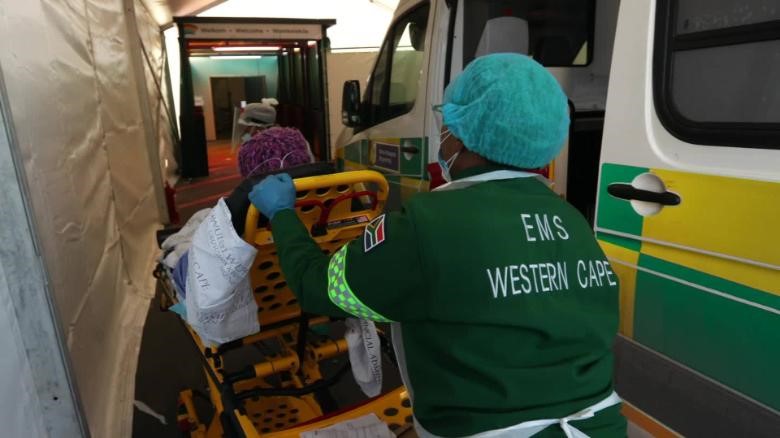
Western Cape is now in the middle of the peak of its coronavirus surge. With more than 69,000 Covid-19 cases and 2,066 deaths, according to July 5 government figures, it is the country's worst-affected province.

"Nobody knew what the Covid epidemic would mean for South Africa. We had seen Covid rip through Europe, we saw what it was doing in the United States and everyone was terrified of what that would mean in South Africa," says Dr. Claire Keene, a medical coordinator for the NGO Doctors Without Borders.

"We are being faced with so much failure with Covid. We have used the time well, but we were always going to question whether we used it enough," she says.
In Khayelitsha, Doctors Without Borders, in partnership with the country's health department, converted a basketball arena into a field hospital to prepare for this surge. Workers in scrubs walk out the back door and wheel in tanks from the forest of oxygen cylinders outside.

Doctors without Borders, in partnership with the Department of Health, converted this basketball arena in Khayelitsha into a field hospital.

There are 70 beds and just a handful of empty spaces. The patients, most of them elderly, come from the immediate surrounding area, key to gaining trust in the local community. Some walk out after just a few days of oxygen and steroid treatment, while others are not so fortunate.

Keene says their field hospital is a level under ICU care, but it is much more than just a recovery ward. It has become a critical way to lessen the burden on local hospitals as the surge peaks.
Many predicted a catastrophe in South Africa by now, particularly with its high burden of HIV and tuberculosis cases, and its overburdened health system.

But public health officials and doctors here concede that their earlier models -- even those that factored in the aggressive lockdown -- were too pessimistic.

 
South Africa battles coronavirus and tuberculosis 02:26

Worst-case scenario
"We have less patients than we have predicted, we have less hospital admissions that we had predicted. And up until now, we have had slightly less deaths than we predicted," says Professor Lee Wallis, Head of Emergency Medicine for the Western Cape Government.

Khayelitsha township, seen here in March, is a high-density area that is being closely watched in the battle against Covid-19.

Yet Wallis and his team plan to have 1,400 extra beds ready for the worst-case scenario. He sits overlooking a still-empty ward in the massive repurposed convention center near Cape Town's waterfront. They expect the facility to be near capacity by the end of July.

Wallis says that HIV burden hasn't had the impact that some feared. Far more critical, he says, are the co-morbidities like hypertension, obesity and diabetes that have also worsened outcomes for Covid-19 globally.

The pandemic struck South Africa later than Europe and North America and experts here have had the benefit of learning from both the mistakes and innovations from earlier hotspots.
Wallis says a move away from putting patients on ventilators to giving them high-volume oxygen made an almost overnight difference in the Western Cape's main hospitals.

Now, instead of being placed in a medically induced coma and breathing through a machine, many of the same type of patients are taking in huge volumes of oxygen through masks or cannulas.
"We look at what is done in higher income countries and we adapt that to a lower income setting and make it work," he says.

While the peak in Cape Town is not as high as they expected, he believes that the surge could last longer than predicted by their earlier models -- even for many months -- a situation that will strain both the health system and a population desperate to get back to some kind of normal.

Undertakers carry coffins after funerals for Covid-19 victims at a Cape Town mosque in June. The Western Cape province is now in the middle of the peak of its coronavirus surge.
Public health officials warn that it's far too early to declare victory against this disease, and they are wary of predictions on virus that is only just over six months old.
The doctors and nurses in Cape Town are still focusing one day and one patient at a time.
"Every death is heavy on the healthcare workers, but when patients come here gasping for breath and they walk out, it is a massive achievement for everyone," says Keene.


[CNN]

Thanks for reading. Follow the page and Share it.

COVID-19: Burundi starts taking thing serious, begins screening


Creator: Berthier Mugiraneza | Credit: AP
Burundi launched a campaign of mass screening for COVID-19 on Monday in the country’s largest city Bujumbura, indicating that the new president is changing policies to combat the spread of the disease.

Named “I won’t get infected and propagate COVID-19,” in the Kirundi language, the new program was launched in three centers in the north, center and south of Bujumbura.

Scores of Bujumbura residents, including students, wore masks as they participated in the screening.
Launching the screening scheme, Health Minister Thaddee Ndikumana said the government is determined to fight the spread of COVID-19.

“With this campaign we are working to provide access to screening for those people could not in the past and we feel that now is the time that we can work together on this problem,” he said. “This is the wish of the government.”

Burundi has reported 191 confirmed cases of COVID-19, according to the Africa Centers for Disease Control and Prevention.

Previous President Pierre Nkurunziza, who died last month of what the government called a heart attack, had been criticized for not taking the pandemic seriously. He expressed the belief that divine protection would largely suffice for protection against COVID-19, allowed large campaign rallies ahead of the presidential election in May and kicked out the World Health Organization’s country director for criticizing the government’s response to the disease.

Some countries and human rights groups have expressed hope that the new President Evariste Ndayisimiye, an ally of Nkurunziza, would chart a new path to fight the disease, but there was little sign of face masks or social distancing at Ndayishimiye’s swearing-in three weeks ago.

But last week, while swearing in new Cabinet ministers, Ndayishimiye surprised many when he declared Covid-19 as “the worst enemy of Burundi” and announced preventive measures against the disease including mass screening wherever they are cases and reducing the price of soap and water.
The screening program launched Monday indicates that Ndayishimiye is indeed taking the threat of the disease more seriously. The health minister issued stronger guidelines, saying that people visiting patients at hospitals must “be supplied with masks and health personnel be equipped with protective masks.” He also said that taxi drivers should clean seats and that passengers should wear masks.
He said, however, that the country will not participate in vaccine trials. “Burundi cannot accept that its people constitute a sample of experimentation,” he said.

Health workers in Burundi have warned that the coronavirus is more serious there than the government admits, Human Rights Watch said last month.

Several workers spoke anonymously to the group, alleging that the National Institute for Public Health is refusing to conduct virus tests or properly inform the public on the extent of infections. They also alleged that a national hotline for COVID-19 often goes unanswered, and that supervisors tell them to keep quiet about shortages of medical equipment.


[AP]

Thanks for reading. Follow the page and Share it.

Coronavirus live updates: Nigeria, South Africa, Uganda, Ghana... cases, deaths and news


Coronavirus live Africa: latest Covid-19 news - 6 July


Africa Covid-19 update:  on Monday 6 July 
According to the latest figures published by John Hopkins University, 11,483,400 cases have been detected worldwide, with 535,027 deaths and 6,214,206 people recovered.
South Africa: 196,750 cases / 3,199 deaths
Nigeria: 28,711 cases / 645 deaths
Ghana: 20,085 / 122 deaths


Thanks for reading. Follow the page and Share it.

Phased reopening in Kenya after months-long coronavirus lockdown


President Uhuru Kenyatta says international flights to resume on August 1 and restrictions to be lifted in main cities.


Kenyan President Uhuru Kenyatta has announced a phased reopening of the country, with the resumption of international flights from August 1 as well as the lifting of internal travel restrictions.


The move on Monday came as pressure mounts to kick-start the country's ailing economy after four months of coronavirus restrictions which have devastated key industries such as tourism.


Kenyatta said in a televised address that international air travel into and out of the territory of Kenya shall resume from August 1, while domestic flights are scheduled to restart on July 15.


He also announced the lifting of a ban of movement in and out of the capital, Nairobi, the port city of Mombasa and northeastern Mandera.

"Today I order and direct that the cessation of movement into and out of the Nairobi metropolitan area, Mombasa county and Mandera county that is currently enforced shall lapse today or at 4am (01:00 GMT) tomorrow, Tuesday, the 7th of July 2020," said Kenyatta.


He, however, extended the current nationwide curfew between 9pm and 4am for a further 30 days and warned he would not hesitate to "revert to lockdown" if the situation worsened.


"In the next 21 days we shall study patterns of interactions and the spread of the disease. Any trends that signal a worsening of the pandemic, we will have no choice but to return to lockdown," he said.

Kenya has confirmed nearly 7,900 cases of the coronavirus as of Monday, with 160 deaths - the highest official figures of fatalities in East Africa.


The outbreak has battered the economy, with the finance ministry projecting growth to slow to 2.5 percent this year from 5.4 percent last year.


Thanks for reading. Follow the page and Share it.

Sunday, July 5, 2020

Two Rockets Fired From Gaza At Israel


File: An Israeli missile is launched from the Iron Dome defence missile system, designed to intercept and destroy incoming short-range rockets and artillery shells, in the southern Israeli city of Ashdod on November 12, 2019, to intercept rocket launched from the nearby Palestinian Gaza Strip.  Jack GUEZ / AFP


Palestinians in the Gaza Strip fired two rockets at neighbouring Israel on Sunday, the Israeli army said, but there was no immediate indication of where they fell.


“Two rockets were fired from the Gaza Strip towards Israeli territory,” said a brief military WhatsApp message that did not elaborate.

There was no immediate claim of responsibility from the Hamas-run Gaza Strip.


Warning sirens sounded in southern Israel but media said that the Iron Dome missile defence system was not activated, implying that the rockets were not headed for populated areas.


Hamas warned Israel in late June that its planned annexation of parts of the occupied West Bank amounted to a “declaration of war”.


The following day two rockets were fired at the Jewish state from  Gaza, triggering a punitive Israeli air raid on Hamas installations in the Palestinian enclave.


On July 1, Hamas fired a volley of rockets into the sea as a warning to Israel not to go ahead with annexation, sources in the Islamist organisation told AFP.


Israel’s proposal to annex its settlements in the West Bank and the Jordan Valley forms part of a broader US peace plan released in January.


The proposals foresee the ultimate creation of a Palestinian state on the remaining West Bank territory and the Gaza Strip.


But the plan falls far short of Palestinian aspirations, with a state on reduced territory and without east Jerusalem as its capital.


Hamas and Israel have fought three wars in recent years, with the latest conflict in 2014 killing 2,251 Palestinians and 74 people on the Israeli side.


Thanks for reading. Follow the page and Share it.

Kanye West Announces 2020 Presidential Run


(FILE PHOTO) US rapper Kanye West


Kanye West, the entertainment mogul who urges listeners in one song to “reach for the stars, so if you fall, you land on a cloud,” claimed Saturday he is challenging Donald Trump for the US presidency in 2020.


“We must now realize the promise of America by trusting God, unifying our vision and building our future. I am running for president of the United States! #2020VISION,” the born-again billionaire rapper tweeted as Americans marked Independence Day.


West offered no further details on his supposed campaign, four months before the November election, and it is unclear if he has officially registered to run for office.


Hundreds of thousands of Twitter users reacted to the star’s announcement and “Kanye” shot to become the top trending term on the platform, although many questioned whether the volatile rapper would go through with his plan and others claimed it was a publicity stunt.


His wife, reality star Kim Kardashian, replied with a US flag emoji, while Tesla CEO Elon Musk wrote: “You have my full support!”


The 43-year-old has mentioned running for president several times and he said last year he would run for president in 2024.


West long ago broke ranks with most of the left-leaning entertainment industry to loudly voice his support for Trump.


In 2018, they met in the Oval Office — a surreal tete-a-tete that included a hug from the rapper as well as an on-camera rant featuring an expletive not often repeated for the White House press corps.


That year, West also delivered a lengthy soliloquy to a president who many deem racist, telling him he loved him — to the dismay of many Democrats and fellow artists.


But in 2019, during an interview with Zane Lowe of Apple Music’s Beats 1 show, he said his support for Trump had been a way to razz Democrats — and announced his own presidential ambitions.


“There will be a time when I will be the president of the US, and I will remember… any founder that didn’t have the capacity to understand culturally what we were doing.”


It was unclear to whom the artist was referring.


The announcement came days after West, who has taken a very public turn towards Christianity in recent years, released a new song, “Wash Us In the Blood,” along with an accompanying video including imagery from recent anti-racism protests.


West has also opened up about his mental health, particularly his struggle with bipolar disorder, telling talk show host David Letterman he feels like he has “a sprained brain, like having a sprained ankle.”

Since 2018, Kardashian has formed her own contacts with the White House as she champions criminal justice reform: she has successfully lobbied Trump to pardon a sexagenarian woman for a non-violent drug offence.


For weeks now Trump, criticized for his response both to the coronavirus pandemic and to anti-racism protests, has been lagging in the polls behind his Democratic rival, Joe Biden.

There was no immediate response to West’s announcement from either candidate Saturday.


[AFP]


Thanks for reading. Follow the page and Share it.

US records 43,742 new COVID-19 cases in 24 hours


The United States notched more than 43,000 new COVID-19 cases in 24 hours, a tally by Johns Hopkins University showed on Saturday, amid a surge of infections around the country.


The Baltimore-based university's tracker showed 43,742 more cases as of 8:30 pm (0030 GMT Sunday), bringing the country's total number of cases since the pandemic began to 2,836,764.


The university also recorded a further 252 fatalities, bringing the total death toll to 129,657.

The uptick in cases came after three consecutive days of record numbers of new infections, including a high of 57,683 on Friday.

Saturday's lower number could be attributed to less reporting on the July 4th national holiday.


The United States is the hardest-hit country in the global pandemic, both in caseload and deaths.


President Donald Trump on Saturday accused China -- where the outbreak originated -- of a cover-up that allowed the illness to race across the globe, but hailed American "scientific brilliance."


"We'll likely have a therapeutic and or vaccine solution long before the end of the year," he said.


[AFP]


Thanks for reading. Follow the page and Share it.

Saturday, July 4, 2020

Boko Haram attacks UN helicopter, kills two


The United Nations on Saturday said two civilians including a five-year-old child were killed and an aid helicopter damaged in a jihadist attack in restive northeast Nigeria.


Boko Haram fighters waging a decade-long insurgency in the region launched the attack in the town of Damasak on Thursday.

UN humanitarian coordinator in Nigeria Edward Kallon said both the fatalities and several others who were injured in the attack were on the ground.


“A UN Humanitarian Air Service helicopter was hit by bullets during the attack. No aid workers were on board at the time and crew members are all safe,” Kallon said in a statement.


“A UN communication seen by AFP said the aircraft was shot as it approached Damasak and the pilots managed to fly back to regional capital Maiduguri 150 kilometres (90 miles) away.

The memo said the UN was suspending rotational flights for one week “to engage with government partners and conduct new risk assessments”.


Helicopters provide a vital link carrying humanitarian personnel and delivering aid to an estimated 7.8 million people in urgent need of assistance across northeast Nigeria.

The 10-year jihadist conflict has killed 36,000 people and forced some 2 million from their home in the region.


Key roads remain too dangerous to travel despite the Nigerian military repeatedly insisting it has largely defeated the insurgents.

The UN has complained of an uptick in attacks targeting aid workers in the northeast of the country.


The area around Damasak on the border with Niger is dominated by the Islamic State West Africa Province, which broke away from jihadist group Boko Haram in 2016.


[AFP]


Thanks for reading. Follow the page and Share it.

Friday, July 3, 2020

HUSHPUPPI FACES UP TO 20 YEARS IN JAIL !!!


Ramon Olorunwa Abbas, 37, a.k.a. “Ray Hushpuppi” and “Hush,” a Nigerian national, arrived in Chicago Thursday evening after being expelled from the United Arab Emirates (UAE). Abbas made his initial U.S. court appearance this morning in Chicago, and he is expected to be transferred to Los Angeles in the coming weeks.

Abbas was arrested last month by UAE law enforcement officials. FBI special agents earlier this week obtained custody of Abbas and brought him to the United States to face a charge of conspiring to engage in money laundering that is alleged in a criminal complaint filed on June 25 by federal prosecutors in Los Angeles.

The affidavit alleges that Abbas and others committed a BEC scheme that defrauded a client of a New York-based law firm out of approximately $922,857 in October 2019. Abbas and co-conspirators allegedly tricked one of the law firm’s paralegals into wiring money intended for the client’s real estate refinancing to a bank account that was controlled by Abbas and the co-conspirators.

The affidavit also alleges that Abbas conspired to launder funds stolen in a $14.7 million cyber-heist from a foreign financial institution in February 2019, in which the stolen money was sent to bank accounts around the world. Abbas allegedly provided a co-conspirator with two bank accounts in Europe that Abbas anticipated each would receive €5 million (about $5.6 million) of the fraudulently obtained funds.

Abbas and others further conspired to launder hundreds of millions of dollars from other fraudulent schemes and computer intrusions, including one scheme to steal £100 million (approximately $124 million) from an English Premier League soccer club, the complaint alleges.

  If convicted of conspiracy to engage in money laundering, Abbas would face a statutory maximum sentence of 20 years in federal prison.


Thanks for reading. Follow the page and Share it.

France rejects new probe into killing of Rwanda's Habyarimana


The appeals court in Paris rejects a request to reopen a probe into the 1994 assassination of Rwanda's president.


French appeals judges have rejected a request to reopen an investigation into the 1994 assassination of Rwanda's President Juvenal Habyarimana, which sparked the genocide that killed 800,000 people.


Families of those who died when Habyarimana's plane was shot down, including Habyarimana's widow Agathe, will bring a challenge to Friday's decision to France's supreme court, their lawyers said.


The appeals court in Paris had been asked to revisit a 2018 decision to throw out a probe against nine members and former members of incumbent President Paul Kagame's entourage in a case that has poisoned relations between the two countries.


A plane carrying Habyarimana, from Rwanda's Hutu majority, was shot down in Kigali on April 6, 1994, triggering a 100-day killing spree targeting mainly members of the Tutsi ethnic minority, but also moderate Hutus.


The plane was struck by at least one missile as it came in to land at Kigali, also killing Burundi's President Cyprien Ntaryamira, another Hutu, on board.


A probe was opened in France in 1998 after a complaint by families of the French plane crew.


The probe


The investigation initially focused on allies of Kagame, a Tutsi who led the Rwandan Patriotic Front (RPF) rebel movement that came to power after defeating the Hutu regime.


Kagame, who became Rwanda's president in 2000, broke diplomatic ties with Paris between 2006 and 2009 after France issued arrest warrants for his allies.


Then in 2012, a report by French experts pinpointed the camp of Kanombe, controlled by Habyarimana's army, as the missile launch site - shifting the investigation's focus.


Kigali said the finding vindicated its belief that the attack was carried out by Hutu people who believed Habyarimana was too moderate and who opposed the Arusha peace process then under way.


As investigations dragged on, Kagame accused France in the run-up to the genocide's 20th anniversary in 2014, of having played a "direct role" in the killing.


And in November 2016, Kigali launched an inquiry into the alleged role of 20 French officials in the genocide that began hours after the plane was brought down.


France has always denied the allegations and last year, President Emmanuel Macron announced the creation of a panel of historians and researchers to look into the claims.


In December 2018, French judges dropped their probe for lack of evidence.


Thanks for reading. Follow the page and Share it.

Tuesday, June 30, 2020

Powerful Explosion Kills 19 In Iran Capital


An image grab from footage obtained from the state-run Iran Press news agency on June 30, 2020, shows footage of a powerful explosion at a clinic in northern Tehran. IRAN PRESS / AFP


A powerful explosion at a clinic in northern Tehran killed at least 19 people on Tuesday, Iran’s semi-official ISNA news agency reported.

The blast at Sina At’har health centre caused damage to buildings in the vicinity and sent a plume of thick black smoke into the night sky, state television reported.


“An explosion was reported at 20:56 (1626 GMT) followed by a fire at Sina At’har clinic. Medical units were dispatched immediately,” Tehran’s emergency medical services said in a statement.


“The death of 13 people has been confirmed. Six have also been injured and transferred” to a hospital, it added.


Tehran fire department spokesman Jalal Maleki also told the agency that firefighters recovered six more who died after the blaze was extinguished around two hours later, raising the toll to 19.


Fifteen of the dead were women, state television said.


In a TV interview, Maleki said the explosion occurred as gas canisters caught fire in the clinic’s basement.


Some of the victims “were in upper floors in operation rooms, who were either patients being operated on or those with them,” he said.

“They unfortunately lost their lives due to the heat and thick smoke.”

The incident comes four days after an explosion near a military complex rocked the Iranian capital.


It took place in the Parchin area in the southeast of Tehran due to “leaking gas tanks”, Iran’s defence ministry said on Friday, adding there were no casualties.


Parchin is a site suspected of having hosted conventional explosion tests applicable to nuclear power, which the Islamic republic denies.

It had come under scrutiny from the UN’s International Atomic Energy Agency in 2015.


Iran had refused the IAEA access to the site because of the nature of its work, but the agency’s then chief, the late Yukiya Amano, paid a visit there.


AFP


Thanks for reading. Follow the page and Share it.

Monday, June 29, 2020

Swine Flu virus with 'pandemic potential' found in China


Nasal swabs from more than 30,000 Chinese pigs over 7 years found an increase in an avianlike influenza virus that has swapped genes from several strains.
 

HONGLEI SUN


What the world doesn’t need now is a pandemic on top of a pandemic. So a new finding that Chinese pigs are more and more frequently becoming infected with a strain of influenza that has the potential to jump to humans has infectious disease researchers worldwide taking serious notice. Robert Webster, an influenza investigator who recently retired from St. Jude Children’s Research Hospital, says it’s a “guessing game” as to whether this strain will mutate to readily transmit between humans, which it has not done yet. “We just do not know a pandemic is going to occur until the damn thing occurs,” Webster says, noting that China has the largest pig population in the world. “Will this one do it? God knows.”


When multiple strains of influenza viruses infect the same pig, they can easily swap genes, a process known as “reassortment.” The new study, published today in the Proceedings of the National Academy of Sciences, focuses on an influenza virus dubbed G4. The virus is a unique blend of three lineages: one similar to strains found in European and Asian birds, the H1N1 strain that caused the 2009 pandemic, and a North American H1N1 that has genes from avian, human, and pig influenza viruses.


The G4 variant is especially concerning because its core is an avian influenza virus—to which humans have no immunity—with bits of mammalian strains mixed in. “From the data presented, it appears that this is a swine influenza virus that is poised to emerge in humans,” says Edward Holmes, an evolutionary biologist at the University of Sydney who studies pathogens. “Clearly this situation needs to be monitored very closely.”


As part of a project to identify potential pandemic influenza strains, a team led by Liu Jinhua from the China Agricultural University (CAU) analyzed nearly 30,000 nasal swabs taken from pigs at slaughterhouses in 10 Chinese provinces, and another 1000 swabs from pigs with respiratory symptoms seen at their school’s veterinary teaching hospital. The swabs, collected between 2011 and 2018, yielded 179 swine influenza viruses, the vast majority of which were G4 or one of five other G strains from the Eurasian avianlike lineage. “G4 virus has shown a sharp increase since 2016, and is the predominant genotype in circulation in pigs detected across at least 10 provinces,” they write.


Sun Honglei, the paper’s first author, says G4’s inclusion of genes from the 2009 H1N1 pandemic “may promote the virus adaptation” that leads to human-to-human transmission. Therefore, “It’s necessary to strengthen the surveillance” of Chinese pigs for influenza viruses, says Sun, also at CAU.


Influenza viruses frequently jump from pigs to humans, but most do not then transmit between humans. Two cases of G4 infections of humans have been documented and both were dead-end infections that did not transmit to other people. “The likelihood that this particular variant is going to cause a pandemic is low,” says Martha Nelson, an evolutionary biologist at the U.S. National Institutes of Health’s Fogarty International Center who studies pig influenza viruses in the United States and their spread to humans. But Nelson notes that no one knew about the pandemic H1N1 strain, which jumped from pigs to people, until the first human cases surfaced in 2009. “Influenza can surprise us,” Nelson says. “And there’s a risk that we neglect influenza and other threats at this time” of COVID-19.

The new study offers but a tiny glimpse into swine influenza strains in China, which has 500 million pigs. While Nelson thinks the predominance of G4 in their analysis is an interesting finding, she says it’s hard to know whether its spread is a growing problem, given the relatively small sample size. “You’re really not getting a good snapshot of what is dominant in pigs in China,” she adds, stressing the need for more sampling in Chinese pigs.


In the paper, Sun and colleagues—including George Gao, head of the Chinese Center for Disease Control and Prevention—describe lab dish studies that show how G4s have become adept at infecting and copying themselves in human airway epithelial cells. The viruses also readily infected and transmitted between ferrets, a popular animal model used to study human influenza. The researchers found antibodies to the G4 strain in 4.4% of 230 people studied in a household survey—and the rate more than doubled in swine workers.


In addition to stepping up surveillance, Sun says it makes sense to develop a vaccine against G4 for both pigs and humans. Webster says at the very least, the seed stock to make a human vaccine—variants of a strain that grow rapidly in the eggs used to make a flu vaccine—should be produced now. “Making the seed stock is not a big deal, and we should have it ready,” Webster says.


China rarely uses influenza vaccines in swine. Nelson says U.S. farms commonly do, but the vaccine has little effect because it’s often outdated and doesn’t match circulating strains.


Ideally, Nelson says, we would produce a human G4 vaccine and have it in the stockpile, but that’s an involved process that requires substantial funding. “We need to be vigilant about other infectious disease threats even as COVID is going on because viruses have no interest in whether we’re already having another pandemic,” Nelson says.


Thanks for reading. Follow the page and Share it.